X-Ray Machine Disposal in Dubai — A Complete Guide for Every Industry That Uses Them
Most people associate X-ray machine disposal with hospitals or dental clinics. In reality, X-ray technology is embedded across Dubai's industrial, security, food, and research sectors — and every single one of those industries faces the same legal obligation when equipment is decommissioned.
In Dubai, disposing of an X-ray machine — regardless of the sector it came from — requires a formal permit from Dubai Municipality, a licensed hazardous waste transporter, and a documented recycling certificate. Handing the equipment to a general waste company, leaving it in storage, or passing it to an unlicensed buyer without documentation creates compliance exposure under both Dubai Municipality regulations and the applicable sector authority for your industry.
This guide explains which industries are affected, why X-ray equipment is regulated waste, what the disposal process requires, and documents a real completed disposal job as proof of the process in practice.
Every Industry That Uses X-Ray Machines in Dubai — And Must Dispose of Them Correctly
Healthcare and Medical
Hospitals, specialist clinics, diagnostic imaging centres, physiotherapy and rehabilitation centres, and orthopaedic facilities operate fixed and portable X-ray units, panoramic dental imaging systems, fluoroscopy equipment, and interventional radiology components. Veterinary clinics also fall within this category.
Dental Practices
Dental surgery clinics, orthodontic practices, and oral health centres operate intraoral X-ray units, panoramic (OPG) machines, and CBCT cone beam imaging systems. These are among the most frequently upgraded pieces of equipment as digital imaging technology advances.
Security and Screening
Airports operate baggage and carry-on X-ray screening systems throughout departure gates and security checkpoints. Hotels, shopping malls, government buildings, embassies, and major event venues operate lobby and entrance screening units. Dubai's ports and customs facilities operate large-scale cargo X-ray and CT scanning systems for container inspection.
Oil, Gas and Industrial Inspection
Upstream and downstream oil and gas companies use industrial X-ray and gamma-ray systems for non-destructive testing (NDT) of pipeline welds, pressure vessel integrity, and structural components. Structural engineering firms, bridge inspection companies, and construction contractors use portable NDT X-ray units for concrete and steel inspection.
Manufacturing and Quality Control
Automotive manufacturers, aerospace component suppliers, and electronics manufacturers use X-ray inspection systems for weld quality, casting integrity, and PCB defect detection. These are high-value industrial systems with defined service lives that require managed end-of-life disposal.
Food Processing and Packaging
Food manufacturing facilities and packaging lines use X-ray inspection systems to detect foreign body contamination — metal, glass, bone, and dense plastic — in packaged goods before distribution. These systems are found across food and beverage production facilities throughout Dubai's industrial zones
Laboratories, Research, and Universities
Research laboratories, university science departments, and pharmaceutical testing facilities operate X-ray diffraction (XRD) analysers, X-ray fluorescence (XRF) spectrometers, and experimental imaging systems. These instruments contain X-ray tubes requiring specialist disposal when instruments are retired or replaced.
Jewellery and Precious Metals
Dubai's gold and jewellery sector uses X-ray fluorescence (XRF) analysers extensively for material composition testing, hallmarking, and quality verification. As one of the world's largest gold trading hubs, Dubai's jewellery industry generates a significant volume of retired XRF equipment requiring regulated disposal.
Why X-Ray Machine Disposal Is Regulated Under Dubai Municipality Rules
All X-ray equipment — across every industry listed above — is classified as W18 E-waste under Dubai Municipality's hazardous waste classification system (Technical Guideline No. 8, DM-WMD-WTS-TG-8). W18 covers Waste Electrical and Electronic Equipment (WEEE), including medical imaging devices, security screening systems, industrial inspection equipment, and laboratory analytical instruments.
The hazardous classification exists because X-ray machines contain components that cannot enter general waste streams safely.
Dubai Municipality's Technical Guidelines (78) for Health Protection Against Ionizing Radiation (DM-HSD-GU78) govern the handling, transport, and disposal requirements for equipment and materials containing ionizing radiation components — the framework under which X-ray machine disposal is classified and managed in the Emirate.
Lead shielding is present in virtually all X-ray units. X-ray tubes contain tungsten, copper, and glass under vacuum. Electronic control systems contain circuit boards with heavy metals. Older units may contain additional regulated materials requiring specialist processing.
Under Dubai Municipality's framework, W18 E-waste disposal requires a WDS (Waste Disposal System) permit issued before any movement of the equipment, collection by a vehicle holding a valid HWTV (Hazardous Waste Transport Vehicle) permit specifically covering W18, RASID GPS-tracked transport to a DM-approved recycling facility, and a Certificate of Recycling issued upon completion confirming compliance.
There is no simplified process for smaller units. An 8 kg dental X-ray unit and a 500 kg cargo scanner both follow the same regulatory pathway.
The Disposal Process — Step by Step
Step 1 — Waste Classification and Permit…
The equipment is confirmed as W18 E-waste. A WDS permit application is submitted through Dubai Municipality's online portal at waste.dm.gov.ae, declaring the equipment type, weight, and facility of origin. Supporting documentation is uploaded as required. The permit is approved by Dubai Municipality's Waste Treatment Section before any collection takes place.
Step 2 — Scheduled Collection
Collection is carried out by a Dotless Environmental Protection Services vehicle holding a valid HWTV permit covering W18 E-waste. The driver carries a copy of the approved WDS permit at the time of collection — a mandatory requirement under Dubai Municipality's transport framework.
Step 3 — RASID-Tracked Transport
Every Dotless vehicle is registered with RASID — Dubai Municipality's Automated Vehicle Tracking and Monitoring System. This creates a verified GPS movement record from your facility to the DM-approved recycling destination, providing a complete chain of custody for your compliance records.
Step 4 — Recycling at DM-Approved Facility
The equipment is processed at a Dubai Municipality-approved recycling facility. All destruction and recycling is carried out in accordance with approved procedures to ensure environmental responsibility and regulatory compliance.
Step 5 — Certificate of Recycling Issued
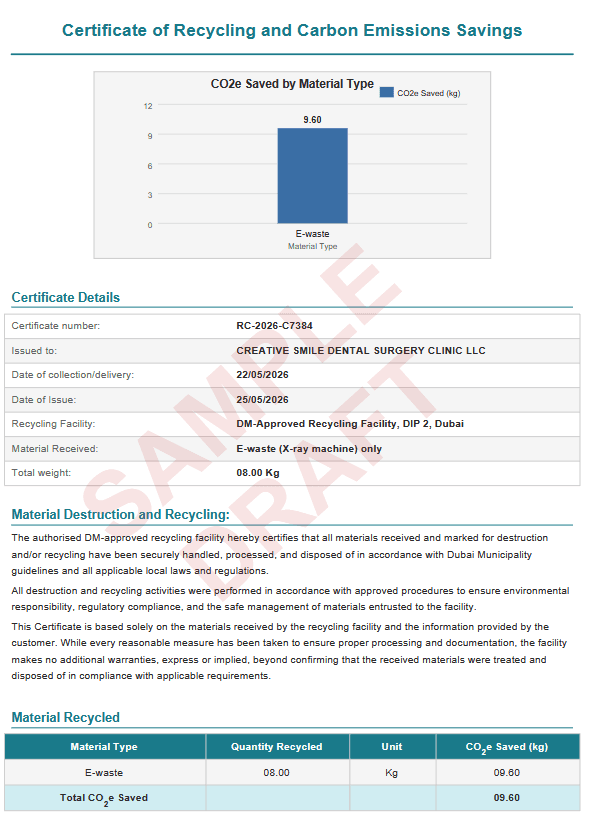
A Certificate of Recycling and Carbon Emissions Savings is issued, documenting the material type, quantity recycled, CO₂ equivalent saved, and confirmation of compliance with Dubai Municipality guidelines. This is your proof of disposal for sector authority audits.
Case Study — Dental Clinic X-Ray Machine Disposal, Dubai (May 2026)
In May 2026, Dotless Environmental Protection Services completed a compliant X-ray machine disposal job for a licensed dental surgery clinic in Dubai.
The clinic had upgraded its X-ray imaging system and required documented disposal of the decommissioned unit. Dotless managed the full process — WDS permit application, HWTV-permitted collection, RASID-tracked transport, and delivery to a DM-approved recycling facility.
Equipment collected: Dental X-ray machine (W18 E-waste) Weight: 8.00 kg Date of collection: 22 May 2026 CO₂ equivalent saved through recycling: 9.60 kg Certificate issued: 25 May 2026
The clinic received its Certificate of Recycling confirming full compliance with Dubai Municipality guidelines and all applicable local regulations — available for DHA facility audits and licence renewals.
This same documented process is available to every industry sector operating X-ray equipment in Dubai.
Download Recycling Certificate (PDF)
What Your Organisation Receives at Completion
Every completed X-ray machine disposal job results in a Certificate of Recycling documenting the equipment type and quantity, the recycling facility and date of processing, the CO₂ equivalent saved through recycling, and confirmation of compliance with Dubai Municipality guidelines.
For healthcare facilities, this satisfies DHA waste disposal documentation requirements. For industrial and manufacturing companies in free zones, it satisfies JAFZA, DIP, DIC, and Dubai South waste compliance requirements. For food processing facilities, it supports Dubai Municipality food safety audit documentation. For security equipment operators, it provides a clean decommissioning record for asset disposal.
Signs Your X-Ray Equipment Has Reached End of Life
Equipment requiring disposal includes systems being replaced as part of a technology upgrade, units failing beyond economic repair, equipment removed during facility renovation or relocation, systems decommissioned following facility closure, and older analogue X-ray units being replaced with digital systems.
Dubai Municipality's WDS permit framework does not differentiate between broken and functional equipment — if your organisation no longer requires the unit and intends to remove it from your premises, it requires regulated disposal regardless of its condition.
Frequently Asked Questions
What waste category is an X-ray machine under Dubai Municipality rules?
All X-ray equipment — medical, security, industrial, food inspection, or laboratory — is classified as W18 E-waste (WEEE) under Dubai Municipality's hazardous waste classification system. This classification applies uniformly across all industries and all equipment sizes.
Do I need a permit before my X-ray machine is collected?
Yes. A WDS permit from Dubai Municipality must be approved before collection takes place. No HWTV-permitted vehicle can legally collect W18 E-waste without a current approved permit accompanying the collection.
Can a general IT or electronics recycling company collect our X-ray machine?
Only if they hold a valid HWTV permit from Dubai Municipality specifically covering W18 E-waste. A general IT recycler, electronics buyer, or scrap metal company without this permit cannot legally transport decommissioned X-ray equipment in Dubai. Verify the HWTV permit number at waste.dm.gov.ae before engaging any contractor.
How long does the full process take?
From initial enquiry to collection and certificate issuance, the process typically takes 5–10 working days depending on Dubai Municipality's WDS permit approval timeline. The collection itself is a single scheduled visit.
Does this apply to X-ray equipment in free zones?
Yes. Dubai Municipality's W18 E-waste framework applies across all of Dubai including JAFZA, DIP, DIC, Dubai South, and all other free zones. Free zone operators are not exempt from the WDS permit requirement.
We have multiple units to dispose of — can they all be handled in one collection?
Yes. Multiple X-ray units or a mixed collection of decommissioned medical or electronic equipment can be covered under a single WDS permit application, subject to weight declaration and correct classification of each unit type.
What is included in the recycling certificate?
The certificate includes the certificate reference number, the organisation name, the date of collection and certificate issue, the material type and quantity in kg, the CO₂ equivalent saved through recycling, and confirmation of compliance with Dubai Municipality guidelines and applicable laws.
Dispose of Your X-Ray Equipment — Any Industry, Any Size
Dotless Environmental Protection Services L.L.C (Trade Licence No. 1483776) is a Dubai Municipality-licensed hazardous waste transporter covering W18 E-waste. Our HWTV-permitted, RASID-tracked vehicles serve healthcare facilities, industrial companies, security operators, food manufacturers, laboratories, and all other industries across Dubai.
Whether you are decommissioning a single dental X-ray unit or clearing an entire equipment room, contact Dotless to arrange a WDS permit, compliant collection, and recycling certificate.
Regulatory Reference: This blog references Dubai Municipality Technical
Guidelines (78) for Health Protection Against Ionizing Radiation (DM-HSD-GU78),
published by the Dubai Municipality Health and Safety Department.
Related posts
Pharmacy Waste Management in Dubai

How to Choose a Medical Waste Company in Dubai
Regulated vs General Medical Waste: Dubai Guide
Ready to get it done?
Tell us what you need and we'll help you find the right service.