Why sharps containers are non-negotiable
A single discarded needle can carry hepatitis B, hepatitis C or HIV, and a needlestick injury turns a routine clinic day into a fitness-for-work investigation and a course of post-exposure prophylaxis. In Dubai, correct sharps handling isn't just good practice — it's a condition of your DHA facility licence and a recurring item on Dubai Municipality inspections.
Yet the sharps container is where most clinics slip. It gets tucked under a bench where nobody can see the fill line, wedged so full the lid won't seal, or — worst of all — tipped into the general bin at the end of a busy shift. Each of those is a citable non-conformity and a genuine injury risk to your cleaners and collection crew.
This guide fixes that. It covers exactly what you need, in what size, and how to keep it compliant from the point of use to final treatment.
Dotless Green Environmental Services has safely collected and disposed of clinical sharps across Dubai since 2017. Sharps collections run under active HWTV permits (HWTV-181225-02457, HWTV-311025-02400, HWTV-160725-02237) on RASID-registered, GPS-tracked vehicles, with every sealed container treated at a Dubai Municipality-approved facility and a disposal record returned to the client. Dotless now serves 800+ clients and handles the sharps stream for 250+ active healthcare facilities each month.
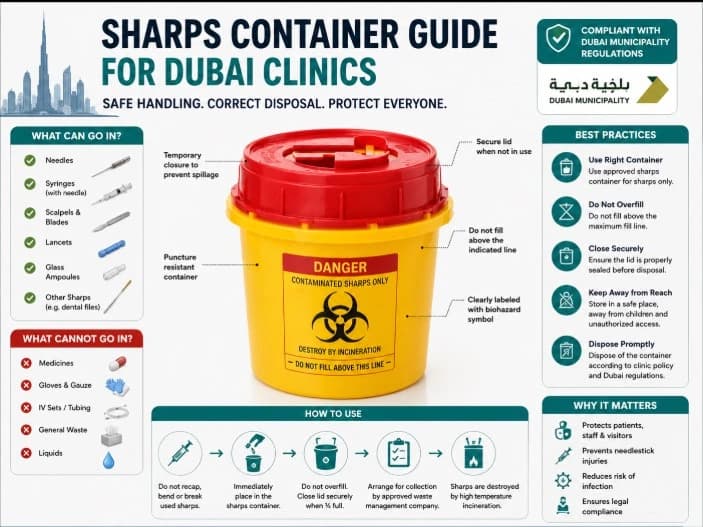
What legally counts as "sharps" waste
"Sharps" is broader than most staff assume. It covers any item capable of puncturing or cutting skin, whether or not it has touched a patient:
Hypodermic, suture and dental needles
Scalpel and surgical blades
Lancets and finger-prick devices
Glass ampoules and broken vials
Blood collection needles and butterfly sets
Contaminated broken glassware from labs
If it can break skin, it goes in the sharps container — never in a biohazard bag, because a needle will pierce the bag and injure whoever handles it next.
Sharps container types and sizes
Containers are matched to the volume and setting, not chosen at random:
0.5–1 L — dental chairs, single treatment rooms, home-visit kits
2–5 L — GP and specialist clinics, vaccination points
7–12 L — busy day-surgery, dialysis, phlebotomy stations
20 L+ — hospital wards and central collection points
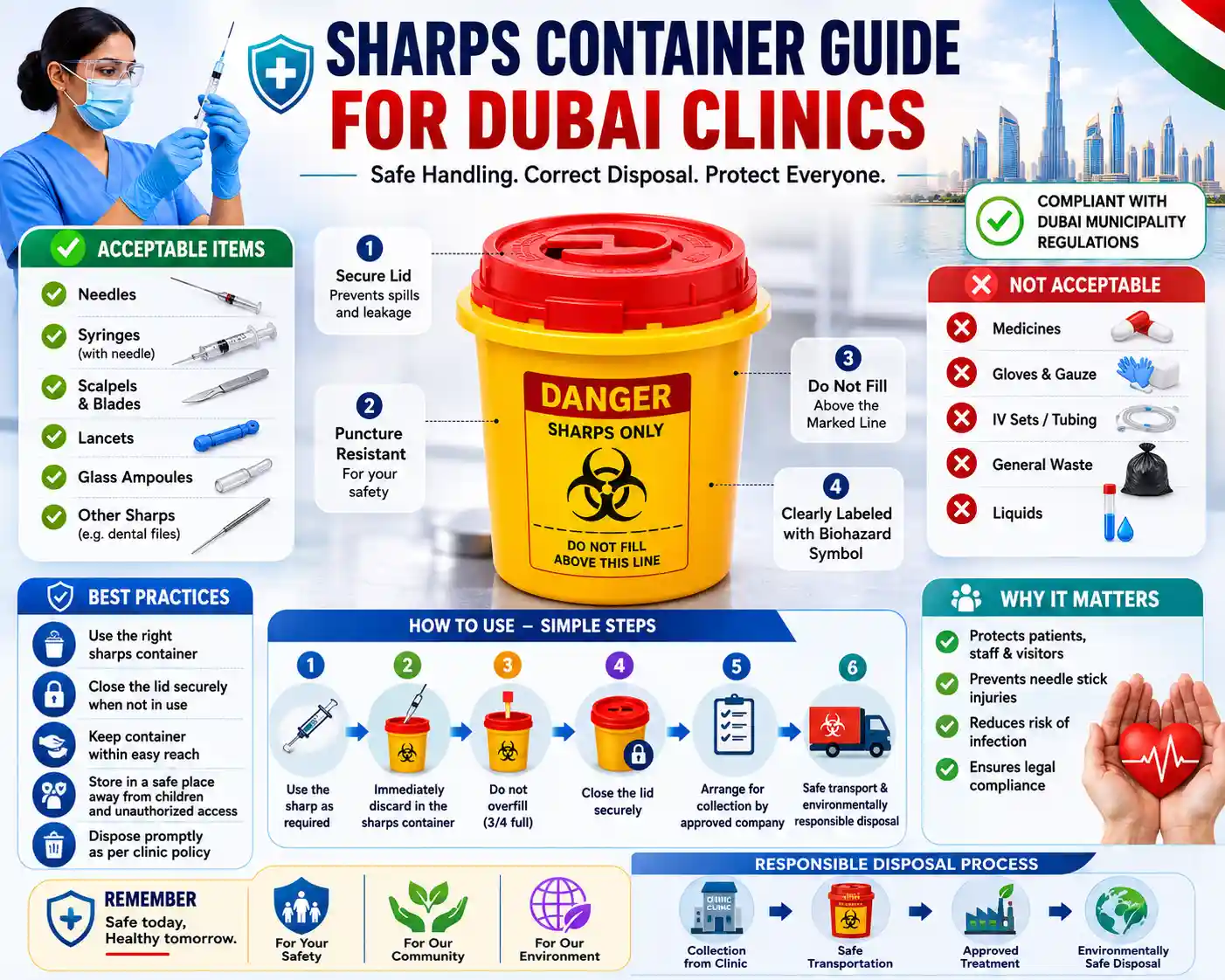
Every container should carry the biohazard symbol, a horizontal fill line, a temporary closure for transport pauses, and a permanent locking lid for final sealing. Reusable systems exist, but single-use rigid containers remain standard for most Dubai clinics.
How to read fill lines and colour codes
Two markings matter. The fill line — usually at roughly three-quarters — is the point at which the container must be sealed and replaced, never topped up. The colour signals the waste stream. In UAE clinical settings, yellow denotes infectious/clinical waste including sharps, while sharps containers themselves are typically yellow with a distinct puncture-proof body. Pharmaceutical and cytotoxic sharps may follow separate coding — confirm your streams with your collector so segregation matches your treatment route
The 8 rules of safe sharps handling
What happens after collection
Compliant sharps disposal doesn't end at your door. Sealed containers must be transported by a carrier holding a valid Hazardous Waste Transport Vehicle (HWTV) permit, tracked in transit, and delivered to a Dubai Municipality-approved treatment facility for high-temperature incineration or equivalent treatment — not landfill. You should receive documentation confirming the waste was treated correctly, which is exactly what an inspector will ask to see.
Choosing a compliant sharps collector in Dubai
The right provider proves compliance on paper, not just in conversation. Look for active HWTV transport permits, RASID-registered vehicles, trained collection crews, and a documented chain of custody from collection to treatment.
Dotless Green Environmental Services collects clinical sharps for clinics, dental practices, labs and pharmacies across Dubai. Collections run under active HWTV permits (including HWTV-181225-02457 and HWTV-311025-02400) using RASID-registered, GPS-tracked transport, with waste treated at DM-approved facilities. Dotless serves 500+ medical waste clients across more than 1,000 clinics and holds a 5.0 rating across 186 Google reviews — the paper trail regulators look for is built into every collection.
Soft CTA: If your sharps stream needs a scheduled, documented collection you can hand to an inspector without hesitation, talk to the Dotless medical waste team.
Frequently Asked Questions
Can I put sharps in a normal biohazard bag if I run out of containers?
No. A needle will pierce the bag and injure the next person to handle it. Keep spare rigid containers on hand and never substitute a bag.
How full can a sharps container be before I seal it?
Seal it at the marked fill line — typically about three-quarters. Filling to the top makes it unsafe to close and is a common inspection finding.
Are sharps containers reusable?
Some hospital systems use robotic-emptied reusable containers, but most Dubai clinics use single-use rigid containers that are sealed and sent for treatment intact.
What size sharps container does a small clinic need?
Most single-room GP or dental clinics use 2–5 L containers at each point of use, with collection frequency matched to how fast they fill.
Who is allowed to collect and transport clinical sharps in Dubai?
Only a carrier holding a valid HWTV permit with approved vehicles. Ask to see the permit before you sign a contract
What documentation should I keep after collection?
A collection manifest and a treatment/disposal confirmation. These form your chain of custody and are what DHA or DM inspectors request.
Related posts
Pharmacy Waste Management in Dubai
How to Choose a Medical Waste Company in Dubai
Regulated vs General Medical Waste: Dubai Guide
Ready to get it done?
Tell us what you need and we'll help you find the right service.