
The Myth That a Pharmacy Only Produces Expired Stock
Walk into almost any pharmacy and ask what waste it needs to dispose of, and you'll hear one answer: expired medicines. It's an understandable assumption — expiry is visible, dated and constant. But it quietly hides the fact that a pharmacy is a multi-stream waste generator, and the streams it forgets are often the ones carrying the strictest rules.
A single Dubai pharmacy can produce expired stock, controlled-drug residues requiring witnessed destruction, cytotoxic products, sharps from on-site vaccinations, cold-chain casualties and pharmaceutical packaging — each with its own compliant route. Treating "expired medicines" as the whole picture is exactly how a pharmacy ends up out of step at licence renewal.
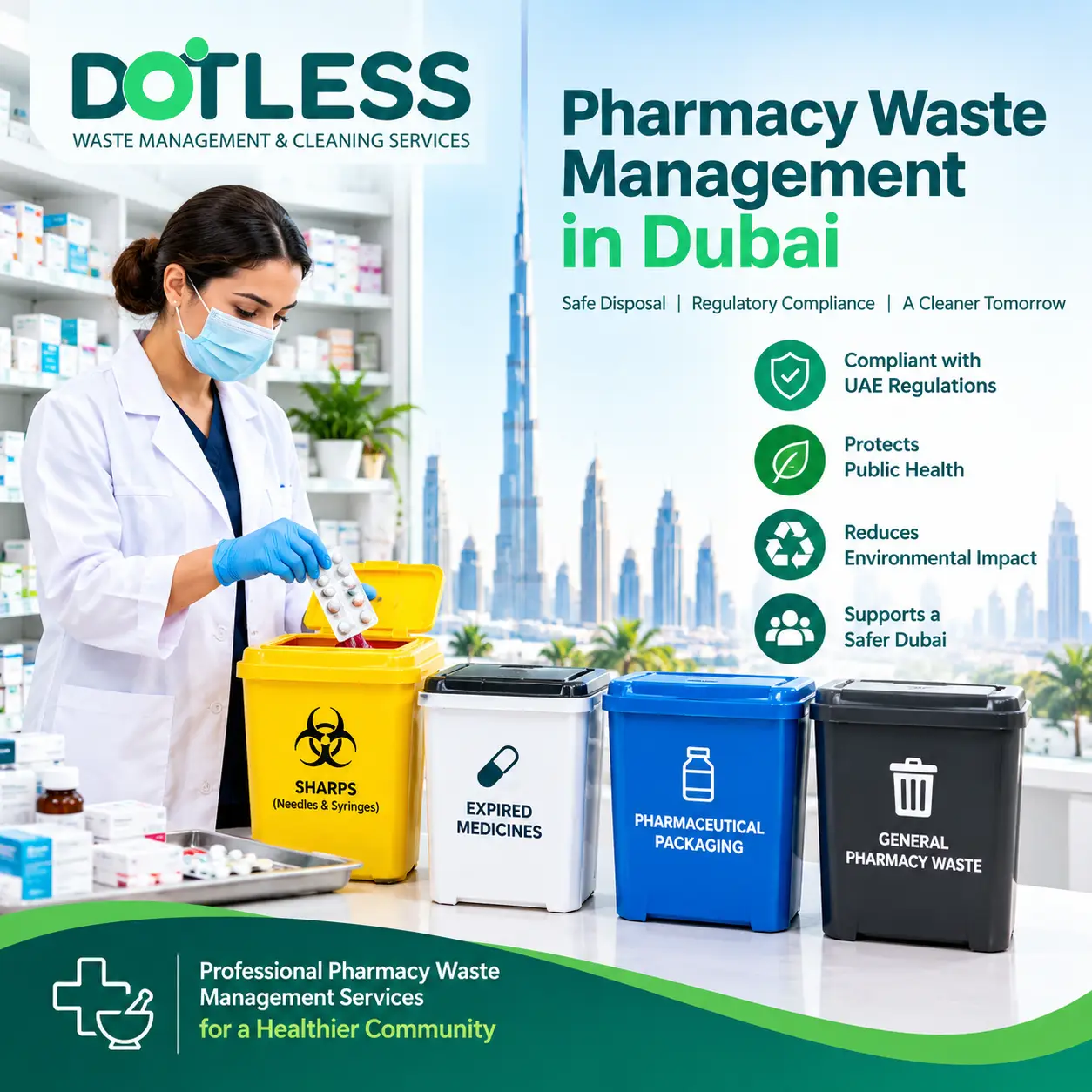
The Full Range of Pharmacy Waste Streams
Expired and Unusable Medicines
Date-expired, damaged or recalled stock
Controlled and Semi-Controlled Drugs
Subject to stricter destruction rules
Cytotoxic/Cytostatic Pharmaceuticals
Hazardous, requiring dedicated handling
Sharps
From vaccination and injection services
Cold-Chain Waste
Products spoiled by temperature excursions
Packaging Waste
Blister packs, bottles, cartons and general recyclables
Expired and Unusable Medicines
Expired, damaged and recalled medicines can't be sold, returned to general waste, or flushed. They're collected as pharmaceutical waste and destroyed through an approved route — and in Dubai this typically ties into the Dubai Municipality disposal certificate process, giving the pharmacy documented proof that its stock was destroyed correctly rather than diverted. That certificate matters at audit as much as the destruction itself.
Controlled and Semi-Controlled Drugs
Controlled and semi-controlled substances sit under a stricter regime than ordinary expired stock. Their destruction generally requires witnessed procedures and specific record-keeping, because regulators need assurance these drugs were genuinely destroyed and not diverted. A pharmacy should never treat controlled-drug waste as routine pharmaceutical waste; it needs the documented, witnessed handling the category demands, coordinated with a licensed provider and the relevant authority requirements
Cytotoxic and Hazardous Pharmaceutical Waste
Cytotoxic and cytostatic products — used in some oncology and specialist contexts — are hazardous and must be segregated from ordinary pharmaceutical waste into dedicated, clearly labelled containers, then treated by a route appropriate to their hazard. Mixing cytotoxics into the general pharmaceutical stream is a serious segregation error.
Sharps from Vaccination and Injection Services
As more Dubai pharmacies offer vaccinations and injections, they now generate clinical sharps — needles, syringes, lancets — that many pharmacy teams aren't set up to handle. These require rigid, puncture-proof sharps containers sealed at the fill line and collected by a licensed carrier, exactly as in a clinic. If your pharmacy administers injections, sharps disposal is no longer optional.
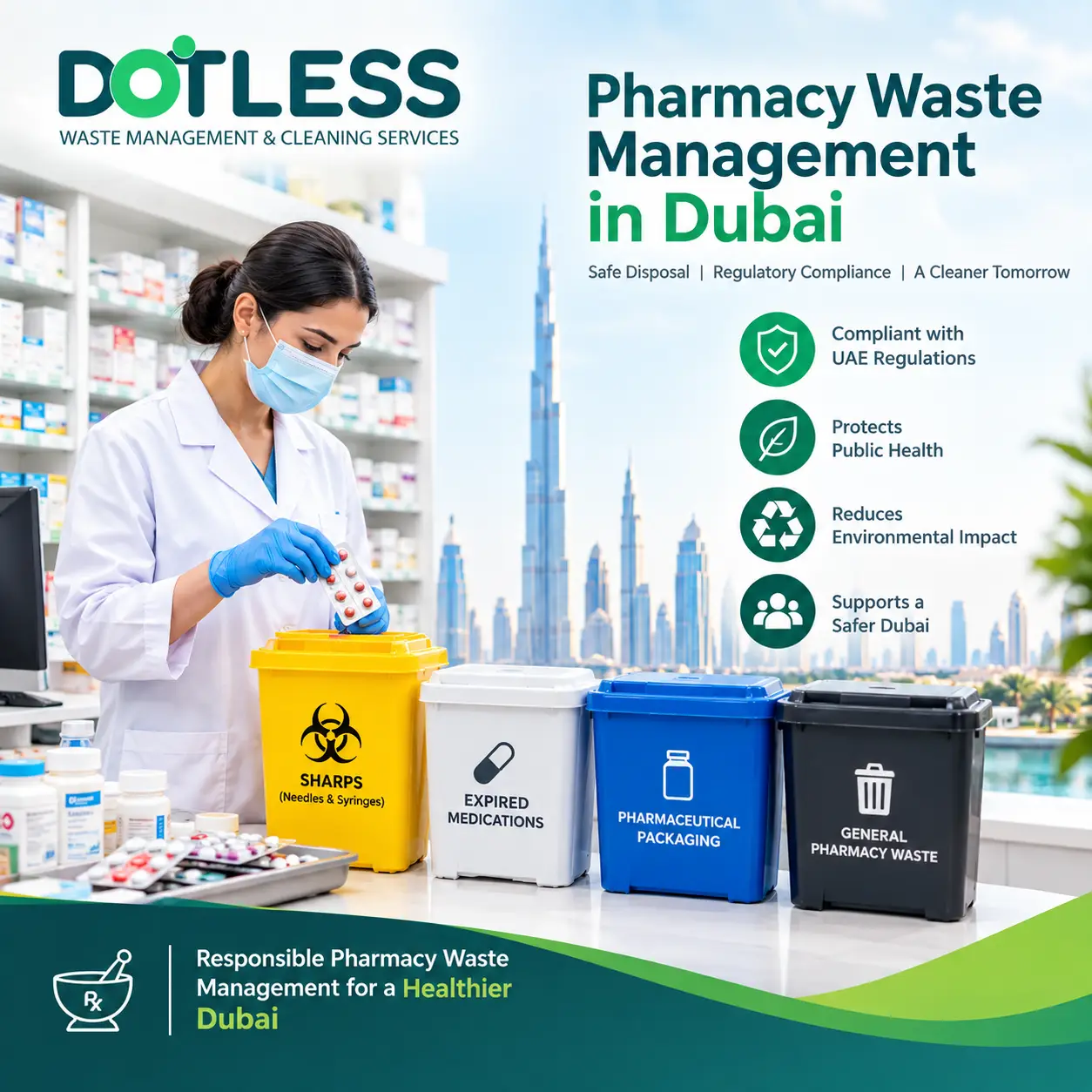
Packaging, Cold-Chain and General Waste
Not everything a pharmacy discards is regulated. Blister packs, empty bottles, cartons and clean packaging are general or recyclable waste and shouldn't be over-classified into the pharmaceutical stream. Cold-chain waste — stock lost to a fridge failure or temperature excursion — is handled as pharmaceutical waste if the product is compromised. Right-sizing these keeps cost down without touching compliance.
Building a compliant pharmacy waste system
A compliant pharmacy sets up containers for each stream — pharmaceutical waste, a separate controlled-drug process, cytotoxic containers where relevant, sharps containers if injections are offered, and general/recycling — with clear labelling and a designated holding area. It maintains destruction records and disposal certificates, and it partners with a licensed collector that can handle every stream under one documented relationship rather than leaving the pharmacy to stitch together several vendors.
Dotless Green Environmental Services provides that single relationship for Dubai pharmacies — collecting expired and pharmaceutical waste, sharps, and hazardous streams, transporting under active HWTV permits (HWTV-181225-02457, HWTV-311025-02400, HWTV-160725-02237) on RASID-registered vehicles, and treating at Dubai Municipality-approved facilities with documentation returned. Serving 500+ medical waste clients across 1,000+ clinics and pharmacies with a 5.0 rating over 186 Google reviews, Dotless helps pharmacies cover every stream, not just the expired shelf.
Soft CTA: If your pharmacy needs one compliant partner for expired stock, controlled drugs, cytotoxics and vaccination sharps, talk to the Dotless medical waste team.
Frequently Asked Questions
Everything you need to know about our services.
No. A pharmacy also generates controlled-drug waste, cytotoxic products, vaccination sharps, cold-chain waste and packaging — each with its own compliant route.