
Why segregation starts the moment waste is created
Every medical waste failure traces back to one decision: which bin the item went into first. Once infectious waste lands in a general bag, or a sharp lands in a soft bag, the mistake can't be undone safely downstream — the whole container is now compromised. That's why regulators treat segregation at the point of generation as the cornerstone of clinical waste management, and why it's the first thing an inspector checks.
Get it right at the bin, and everything after — storage, transport, treatment, documentation — falls into place. Get it wrong, and no amount of downstream handling fixes it.
Correct segregation is something Dotless Green Environmental Services manages across 250+ active healthcare facilities every month — part of a medical waste operation serving 800+ clients in Dubai since 2017. Segregated clinical waste is collected under active HWTV permits (HWTV-181225-02457, HWTV-311025-02400, HWTV-160725-02237), moved on RASID-tracked vehicles, and treated at Dubai Municipality-approved facilities with documentation returned to the client.
The regulatory basis in Dubai
Clinics operating in Dubai fall under Dubai Municipality environmental requirements and, for licensed health facilities, Dubai Health Authority standards for clinical waste handling. Both expect documented segregation, correct containment, licensed transport and treatment at approved facilities. Segregation isn't a housekeeping preference here — it's part of how you keep your facility licence and pass renewal inspections.
Bags, bins and containers — what each stream needs
General (non-clinical) waste
Standard black bags in ordinary bins. Paper, packaging, non-contaminated items.
Infectious/clinical waste
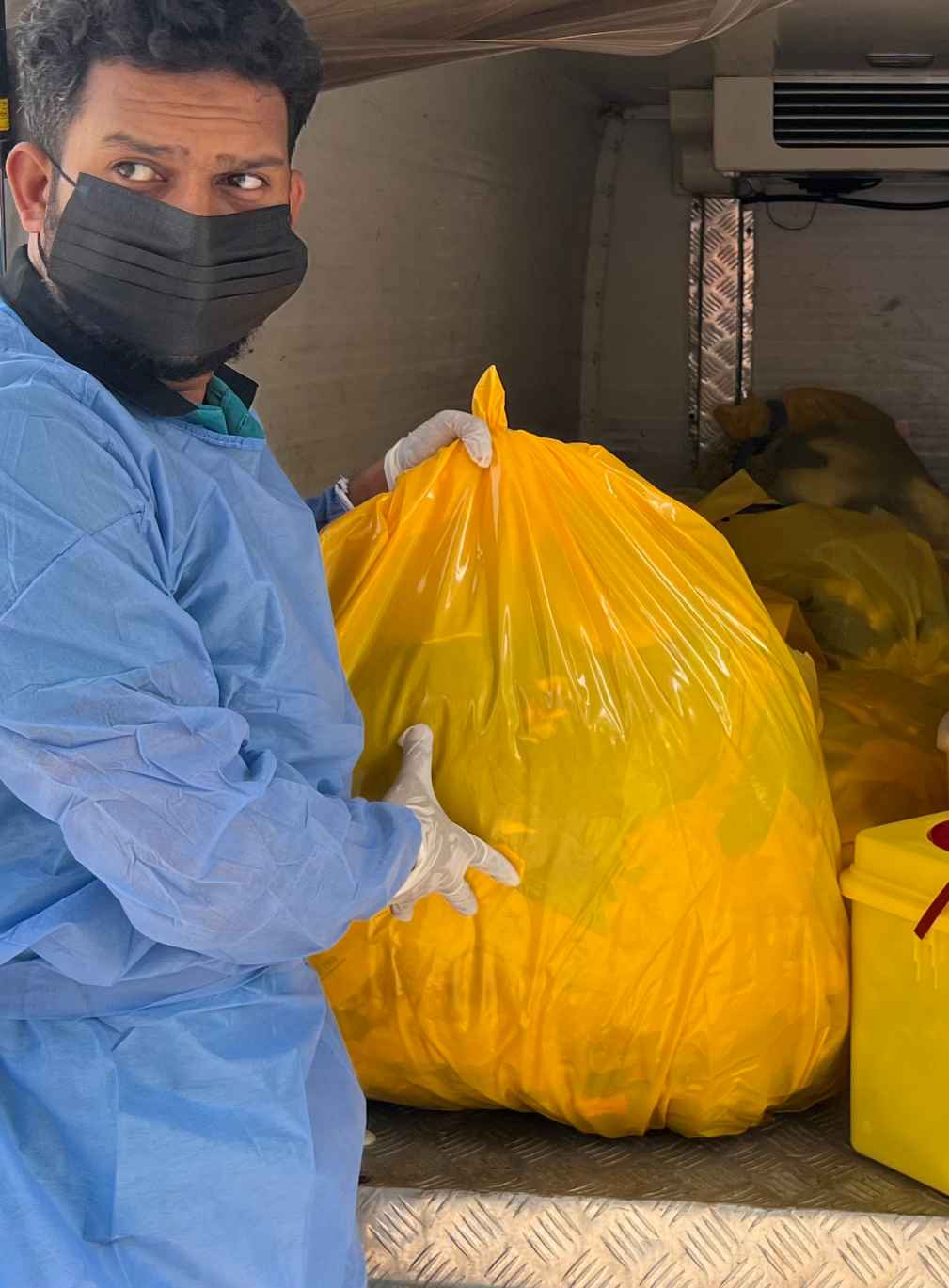
Yellow clinical-waste bags in foot-operated, lidded bins. Dressings, swabs, gloves, contaminated single-use items.
Sharps
Rigid, puncture-proof yellow containers with fill lines. Needles, blades, lancets, glass.
Pharmaceutical waste
Separate labelled containers for expired or unused medicines.
Cytotoxic/cytostatic waste
Dedicated purple-coded containers where applicable.
The colour-coding system explained
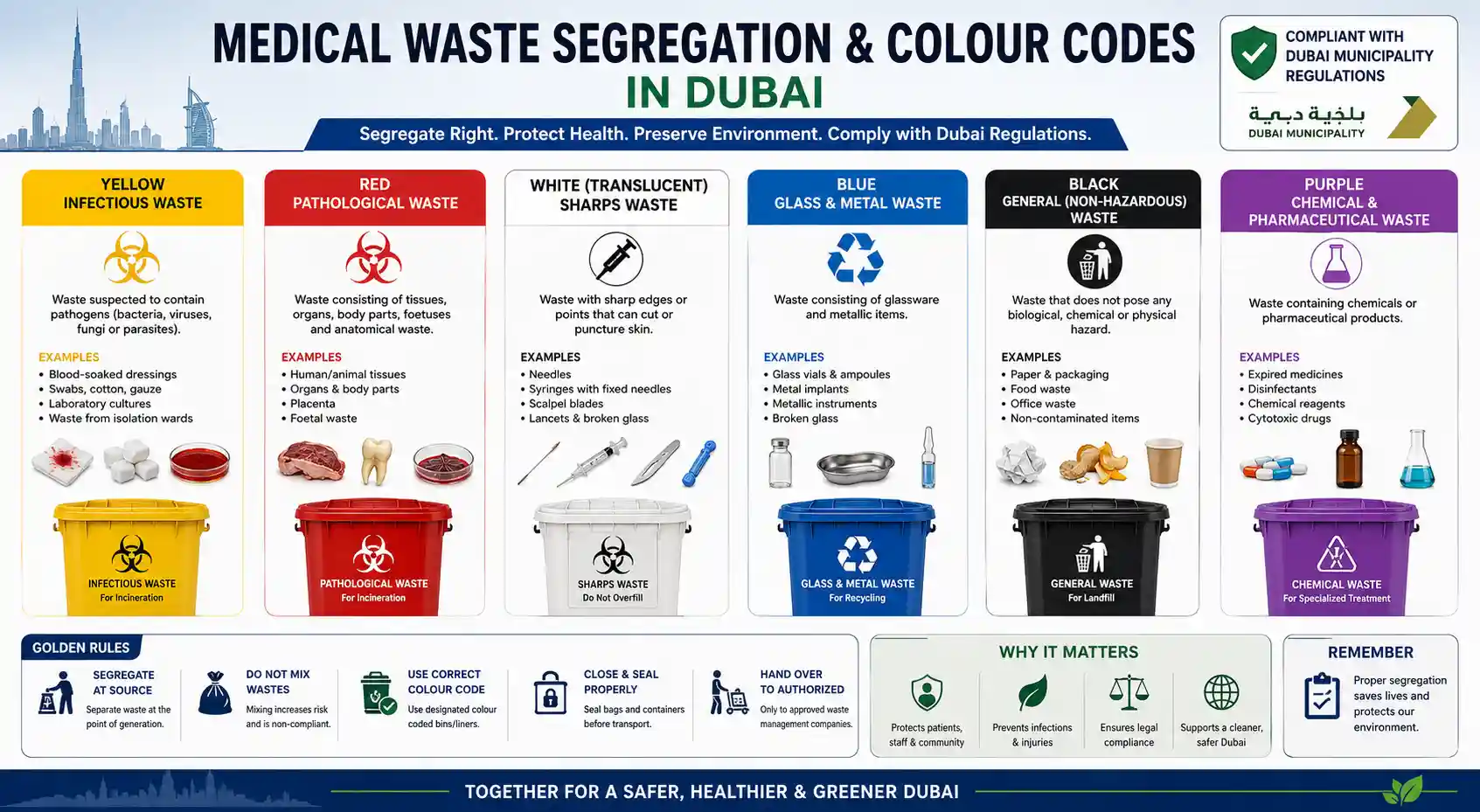
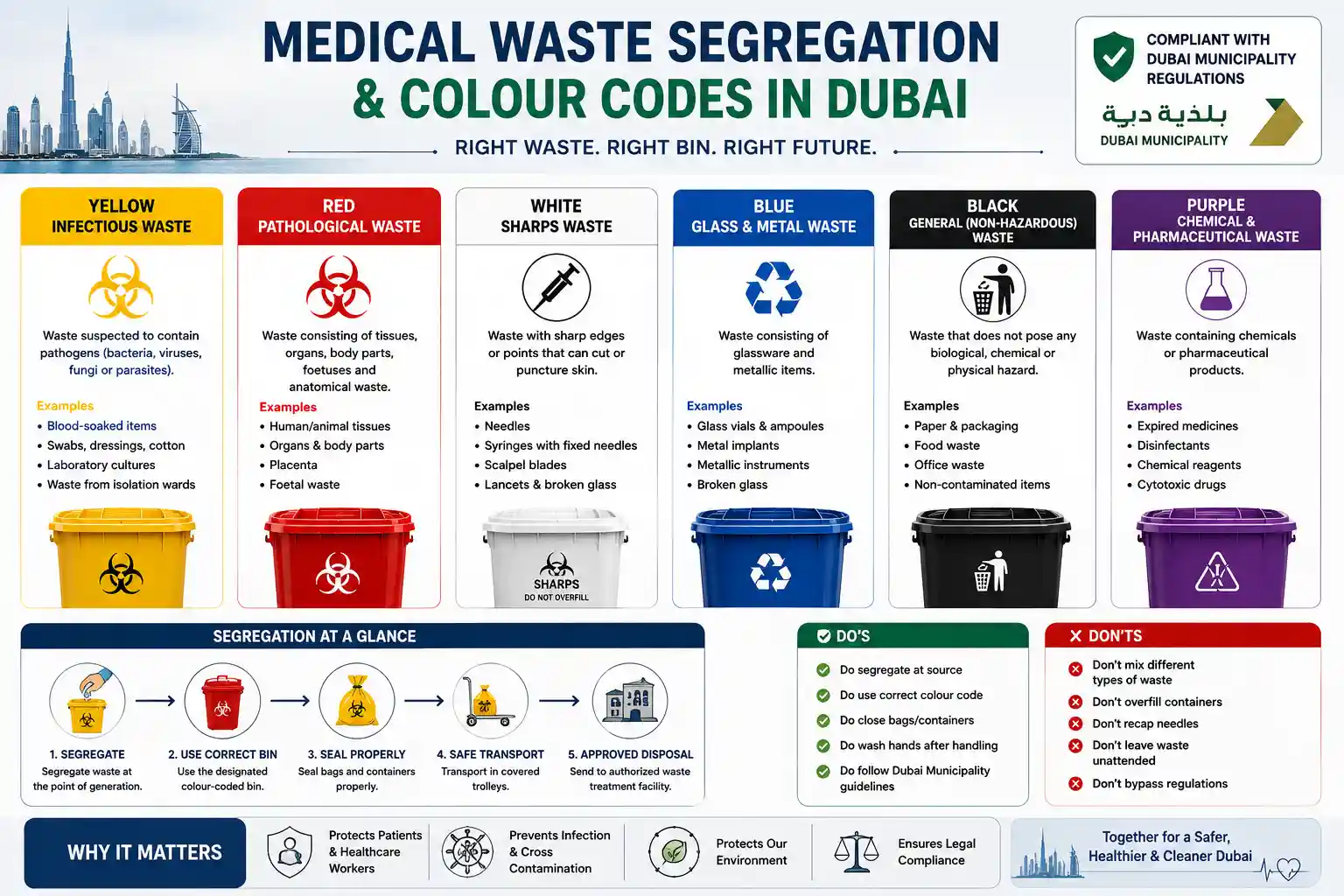
Colour is a language every handler downstream reads instantly. Yellow signals infectious/clinical waste requiring high-temperature treatment. Black signals general waste for the standard municipal stream. Rigid yellow signals sharps. Purple signals cytotoxic waste. Red biohazard bags appear in some settings for anatomical or highly infectious material. The exact palette should be confirmed with your collector so your bins map cleanly onto the treatment route your waste actually takes — but the principle is universal: the colour dictates the destination.
Common segregation mistakes that fail inspections
General waste tossed into yellow clinical bags "to be safe" — inflates hazardous volume and cost.
Sharps dropped into soft clinical bags instead of rigid containers.
Over-filled bags that can't be tied and sealed.
Bins without foot pedals, so staff touch contaminated lids.
No segregation signage at the point of generation.
Storage of filled bags in patient or public areas.
Each of these is a routine finding — and each is avoidable with the right station design.
Building a segregation station that staff actually use
Compliance holds up when the correct bin is the easiest bin to reach. Put the right container at every point of generation, label each with clear colour and pictogram signage, keep sharps containers at eye level, and never make staff carry waste across a room to sort it. Train new joiners on day one and re-brief the team at each renewal cycle. The goal is simple: when a nurse has one free hand and three seconds, the correct choice should be automatic.
From bin to treatment: the compliant chain
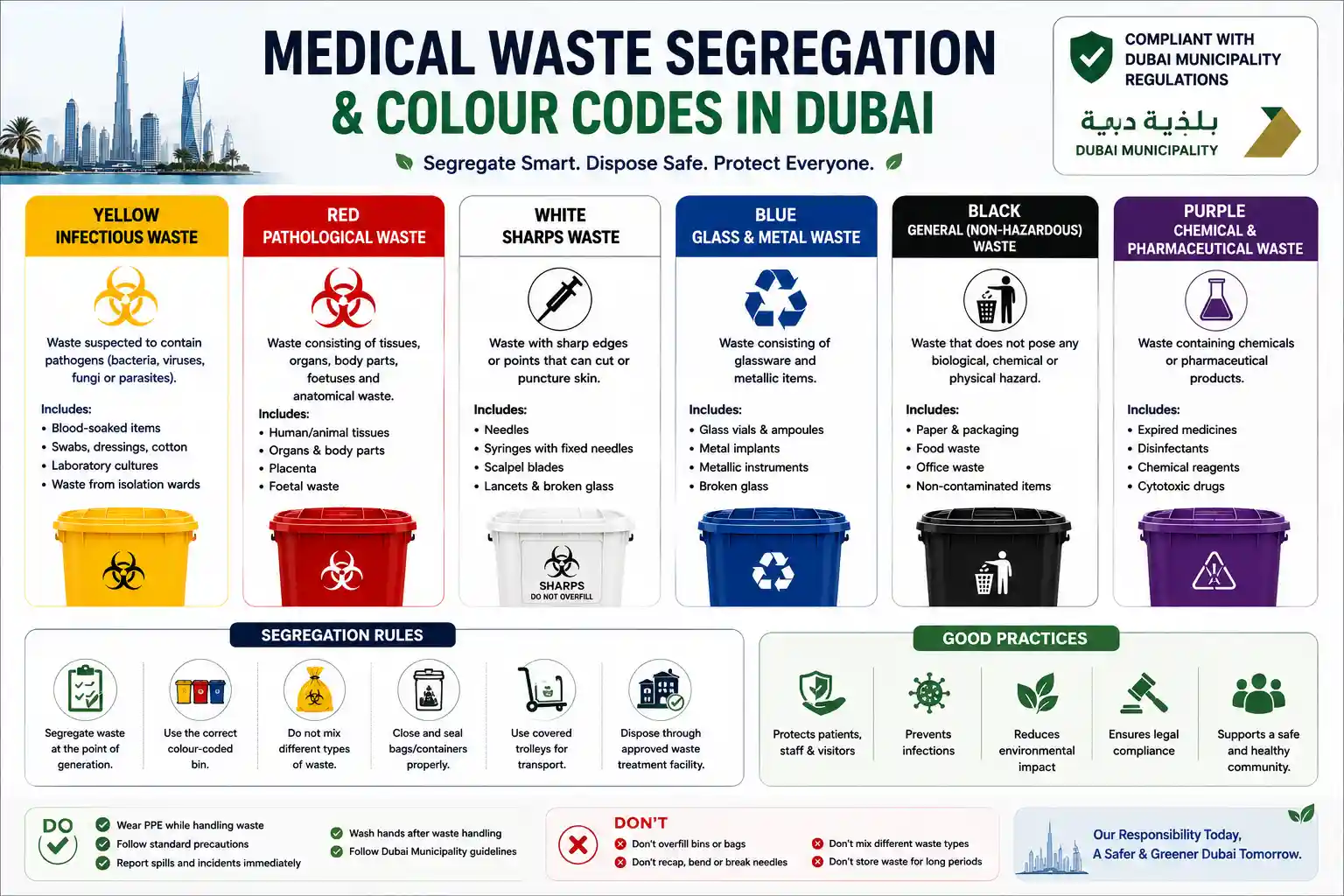
Correctly segregated waste is only compliant if the chain after the bin holds. Filled bags and sealed containers move to a restricted internal holding area, then to a licensed carrier for transport under a valid HWTV permit, and on to a Dubai Municipality-approved treatment facility. Documentation follows the waste the whole way.
Dotless Green Environmental Services closes that chain for Dubai clinics — supplying scheduled collection of segregated clinical waste, transporting under active HWTV permits (HWTV-181225-02457, HWTV-311025-02400, HWTV-160725-02237) on RASID-registered vehicles, and delivering to approved treatment facilities with full documentation. Correct segregation at your bin plus a licensed collector at the door is the complete, inspection-ready system.
Soft CTA: If you want your bins, bags and collection schedule aligned to one clean, documented system, the Dotless medical waste team can set it up.
Frequently Asked Questions
What colour bag is medical/clinical waste in Dubai?
Infectious and clinical waste goes in yellow clinical-waste bags; sharps go in rigid yellow puncture-proof containers. General waste stays in black bags.
Can I put general waste in a yellow clinical bag to be safe?
No — it inflates your hazardous waste volume and cost, and mixing streams is itself a segregation error inspectors flag.
Do medical waste bins need foot pedals?
Hands-free, foot-operated lidded bins are strongly preferred because they prevent contamination from touching lids and keep staff safe.
What are red biohazard bags used for?
In some settings red bags are used for anatomical or highly infectious material. Confirm your exact colour scheme with your collector so it matches your treatment route.
Where should filled clinical waste bags be stored before collection?
In a designated, restricted holding area away from patients and the public — never in treatment rooms, corridors or reception.
Who collects segregated medical waste in Dubai?
A licensed carrier holding a valid HWTV permit. Dotless Green Environmental Services provides scheduled collection and treatment across Dubai.
Related posts
Pharmacy Waste Management in Dubai

How to Choose a Medical Waste Company in Dubai

Regulated vs General Medical Waste: Dubai Guide
Ready to get it done?
Tell us what you need and we'll help you find the right service.