Dubai's 18 Hazardous Waste Categories Explained — Which One Does Your Business Fall Under?
Most WDS permit rejections in Dubai happen before a single form is filled in. The reason is almost always the same: the applicant did not correctly identify their waste category, attached the wrong lab report, or submitted incomplete documentation for their specific waste type.
Dubai Municipality classifies all hazardous waste into 18 distinct categories — W1 through W18 — under Technical Guideline No. 8 (DM-WMD-WTS-TG-8). Each category has its own document requirements, laboratory analysis parameters, storage rules, and disposal fees. Getting this wrong does not just delay your permit. It means starting the entire application over.
This guide breaks down every category, tells you which one applies to your business, and lists exactly what you need to prepare before submitting a WDS application.
Why the Waste Category Matters Before You Apply
When you submit a WDS permit application through waste.dm.gov.ae, the first thing Dubai Municipality's reviewers check is whether your declared waste matches the category, your attached documents match that category, and your lab analysis covers the parameters required for that category.
A manufacturer submitting a wastewater analysis report for a chemical waste application, or a clinic submitting a standard hazardous waste form for pharmaceutical disposal, will be rejected at the screening stage — no exceptions.
Knowing your category upfront is not administrative paperwork. It determines which lab tests to commission, which photos to take, which supporting certificates to obtain, and which disposal fees to budget for. All of that must be in order before the application is submitted.
The 18 Hazardous Waste Categories in Dubai (W1–W18)
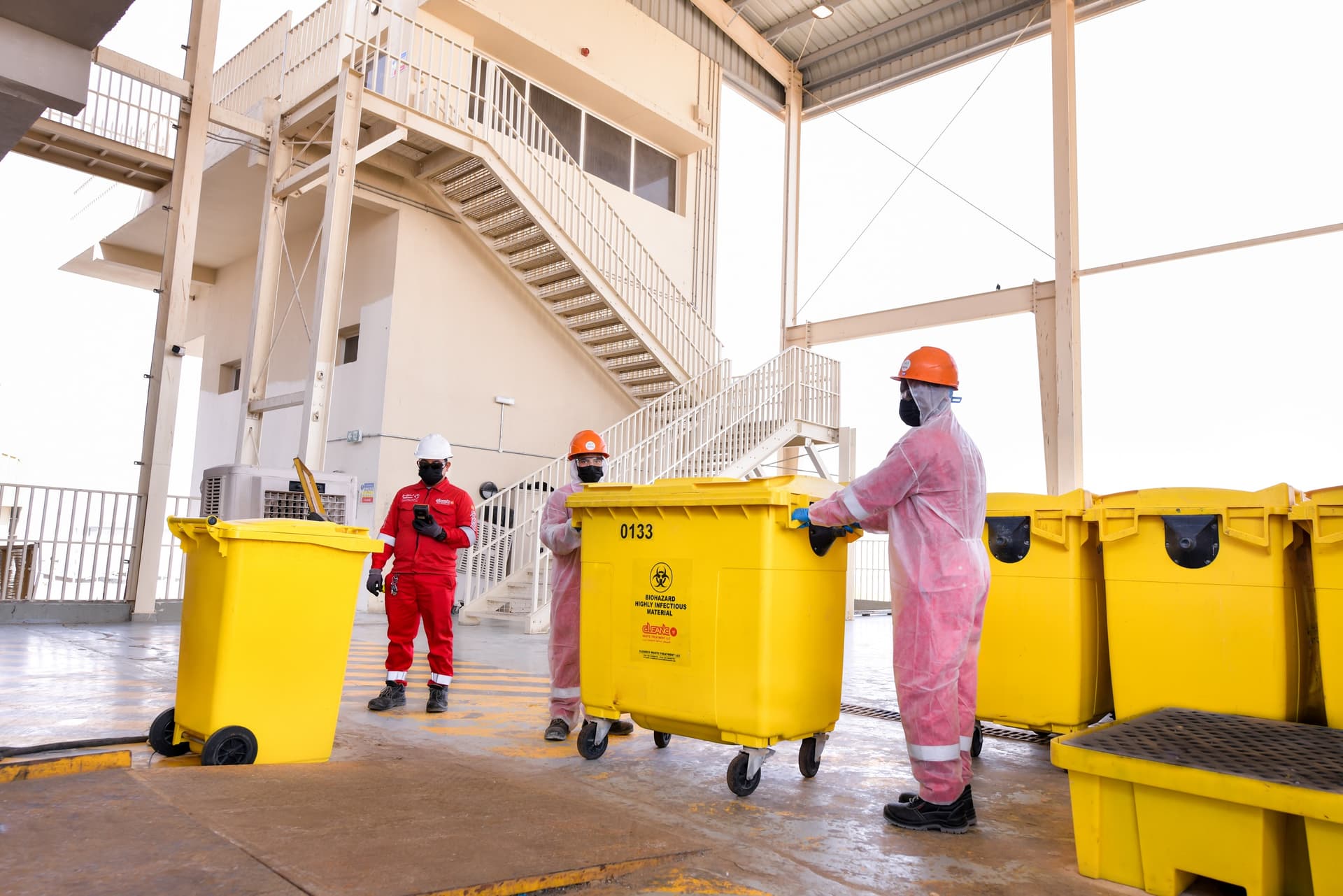
W1 — Medical and Infectious Waste
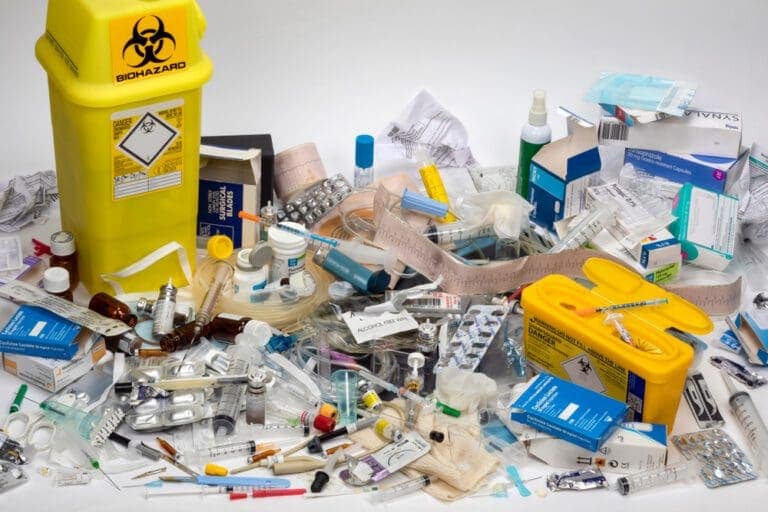
Covers human-based clinical and biomedical waste, waste from veterinary clinics, and infected dead animals. If your facility is a hospital, clinic, dental practice, laboratory, or veterinary centre, this is your primary category.
Medical waste handling and disposal follows the Dubai Code of Practice on Management of Medical Wastes from Hospitals, Clinics, and Related Health Care Premises (1997) alongside TG No. 8.
W2 — Wastewater
Covers all liquid hazardous wastewater from inorganic and organic sources, including vehicle maintenance wastewater, ink and painting wastewater, food industry effluent, and oily wastewater. This is the most common category for industrial facilities, workshops, restaurants, and food processing plants.
Important: Any business generating 300 m³ or more of hazardous wastewater per year must install an onsite wastewater treatment plant, or subcontract treatment to a Dubai Municipality-approved third-party facility.
W3 — Paint, Resin, Ink, and Latex
Covers expired or unused paint products (solid and liquid), and residues from painting or coating processes. Applies to manufacturers, printing companies, construction contractors, and industrial facilities using coating systems.
W4 — Contaminated Materials
A broad category covering contaminated empty chemical containers, used oil filters, contaminated rags, contaminated soil, and — critically — empty pesticide containers (sub-class 4.6). Pest control companies, construction sites, and automotive workshops commonly fall under W4.
Note for empty tin cans under W4: containers must be pressed and flattened at the generator's site before collection for transport.
W5 — Organic Waste
Covers organic waste treatment residues, expired organic chemical products, process refuse, digested STP sludge, and pump pit or holding tank cleaning waste. Relevant to wastewater treatment operators, industrial plants, and tank cleaning contractors.
Sludge under W5 must be dewatered to spadable consistency with no free liquid before sample collection for lab analysis.
W6 — Inorganic Waste
Covers inorganic waste treatment residue solids, expired inorganic chemical products, spent catalysts, and inorganic process refuse. Applies to chemical manufacturers, refineries, and industrial process facilities.
W7 — Grits Waste
Covers abrasive blast media including garnet (blasting activity), waterjet cutting abrasives, iron and metal grits, copper grits, and non-metallic abrasive media. Applies to metal fabrication companies, shipyards, and industrial surface treatment operations.
W8 — Pharmaceutical Waste
Covers expired solid and liquid medicines, drugs, and pharmaceuticals; waste from pharmaceutical manufacturing or formulation; and controlled substances and antineoplastics. Applies to pharmacies, hospitals, drug distributors, and pharmaceutical manufacturers.
Additional requirement for W8: drug distributors and traders must obtain a Medicine Disposal Certificate approved by the Ministry of Health before submitting their WDS application.
W9 — Pesticides and Biocide
Solid and aqueous pesticide and biocide waste. Applies to pest control companies and agricultural operations. Closely related to W4 sub-class 4.6 (empty pesticide containers) — the active pesticide waste itself falls under W9.
W10 — Organic Solvents
Covers spent solvents in liquid form, solvents mixed with solids, expired unused solvents, and used perchloroethylene from dry cleaning operations. Dry cleaning businesses, laboratories, and industrial cleaning operations fall here.
W11 — Inert and Asbestos Waste
Covers both friable and non-friable asbestos waste. Applies to demolition contractors, construction companies, and facility managers involved in building renovation. Asbestos waste must be handled per the Technical Guideline for Safety in Handling Asbestos, with photos attached to the application.
W12 — Metal Treatment Waste
Sludge and aqueous waste from metal processing and treatment operations. Applies to electroplating facilities, metal finishing operations, and engineering workshops.
W13 and W14 — Acid and Alkali Waste
Solid and aqueous acid waste (W13) and solid and aqueous alkaline waste (W14). Common in laboratories, swimming pool chemical operations, cleaning chemical manufacturers, and battery facilities. Chemical wastes must be segregated and applied for separately by compatibility — incompatible chemicals cannot be combined in a single application.
W15 — Waste Chemicals
Covers school and institutional laboratory chemicals and expired unused chemical products. Educational institutions, research facilities, and chemical distributors fall under this category.
W16 — Oily Waste
Covers waste lubricating oil and similar oils (liquid), oil sludge, and other oil-contaminated wastes. Applies to vehicle workshops, marine operations, industrial facilities, and tank cleaning contractors handling oily sludge.
W17 — Explosives and Reactive Wastes
Covers substances that give off heat when exploding, emit toxic fumes, react violently with water, or include flares and safety devices. For flammable wastes with a flash point below 60°C, a separate disposal request must be submitted — this category cannot be combined with other waste types.
W18 — E-Waste and Special Wastes
Covers waste electrical and electronic equipment (WEEE), spent lead-acid batteries, lithium-ion and NiMH batteries, pressurised gas cylinders and aerosols, and mercury-containing waste (thermometers, switches, fluorescent lighting). Applies to electronics retailers, IT companies, healthcare facilities, and any organisation decommissioning electronic assets.
Aerosol and pressurised containers cannot go to landfill. They must be fully depressurised and punctured before disposal. Proof of this must be included in the application.
Download Dubai Municipality Hazardous Waste Disposal Guidelines
What Lab Analysis Your Category Requires
Once you know your category, you must commission the correct laboratory analysis from an EIAC-accredited laboratory. The report must not be older than one month from sampling date for wastewater, and sampling must be carried out at your facility by the laboratory.
For W2 wastewater: pH, TSS, TDS, BOD5, COD, oil and grease, sulfates, sulfides, ammonia nitrogen, and a full heavy metals panel including aluminium, arsenic, cadmium, chromium, copper, lead, manganese, mercury, nickel, silver, selenium, and zinc. Metal processing facilities add chlorides, cyanides, fluoride, and iron. Food processing facilities add fecal coliform and E-coli.
For W4, W5, W6 sludge and contaminated soil: pH, percentage solids, moisture content, chloride, oil content, flash point, metal concentration, and metal TCLP values. Fuel spill contamination over 10 litres adds Total Petroleum Hydrocarbon and BTEX analysis.
For W3, W10, W15, W16 chemicals, inks, paints, and solvents: pH, percentage solids, volatiles, hydrocarbon content, water content, flash point, oil content, and heavy metals.
For consistently generated non-wastewater (W3, W4, W16 etc.) after five years of applications for the same waste type: annual lab analysis is sufficient. For regular hazardous wastewater generators: semi-annual analysis is required.
Disposal Fees by Waste Type
The fee schedule is set under Executive Council Resolution No. 58 of 2017 and applied per metric ton. Any fraction of a ton is charged as a full ton.
General hazardous waste (except wastewater): AED 200–500 per ton. Hazardous waste in 200-litre drums: AED 700 per ton. Flammable waste and W17 requiring special treatment: AED 1,000 per ton. Wastewater exceeding sewer discharge limits: AED 200–500 per ton. Empty chemical containers (W4): AED 400 per ton. Contaminated materials: AED 200 per ton. Empty contaminated bags: AED 100 per 100 kg. W1 medical waste from private sector: AED 6 per kg. W1 medical waste from government sector: AED 3 per kg.
Businesses that want a Destruction Certificate as formal proof of disposal pay an additional flat fee of AED 250, applied separately through the WDS system after disposal is completed.
What to Do Once You Know Your Category
With your waste category confirmed and your lab report commissioned, you are ready to begin the WDS application at waste.dm.gov.ae. You will need a UAE Pass or Dubai Municipality User Management ID to access the system.
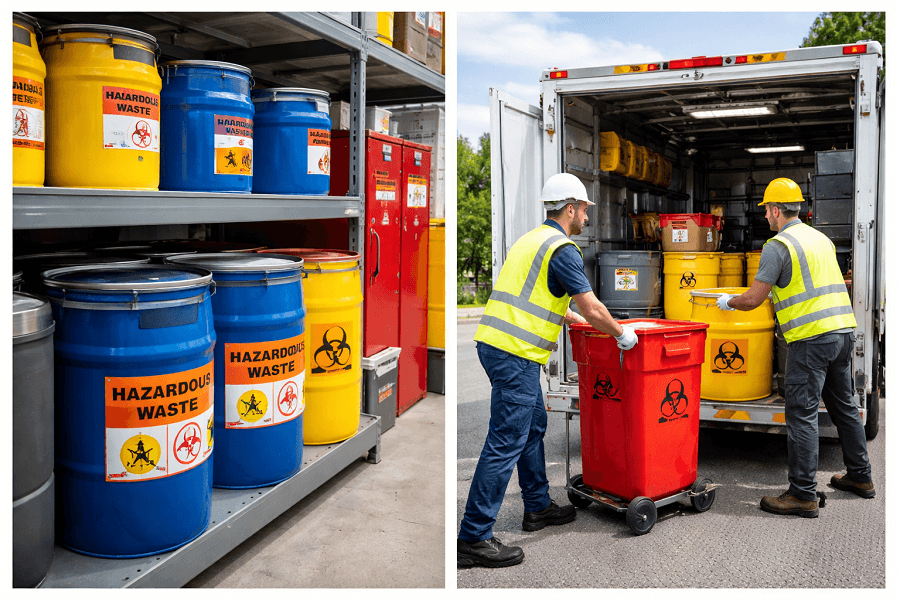
Attach all required documents in PDF format only — the system does not accept other file formats. Include waste photos, container photos, label photos showing manufacturing and expiry dates, and photos of the storage area.
Once your WDS permit is approved, it is valid for three months. No extensions are granted. You must arrange transport through a licensed hazardous waste transporter holding a valid HWTP (Hazardous Waste Transporter Permit) for your specific waste category, with a RASID GPS-equipped vehicle.
Dotless Green Environmental Services L.L.C holds active HWTP permits covering waste Types A, B, G, H1, and H2 — with a RASID GPS-tracked fleet ready to collect from your Dubai facility once your WDS permit is in hand.
Not sure which category your waste falls under, or need a licensed transporter once your permit is approved?
Related posts
Pharmacy Waste Management in Dubai
How to Choose a Medical Waste Company in Dubai
Regulated vs General Medical Waste: Dubai Guide
Ready to get it done?
Tell us what you need and we'll help you find the right service.