This is the point most property managers and building owners do not fully appreciate until a job goes wrong.
An underground tank is a confined space. It is an enclosed or partially enclosed structure — large enough for a person to enter and perform work, not designed for continuous human occupancy, and containing known hazards relating to atmosphere, engulfment, or configuration.
In Dubai, confined space entry is governed by UAE Federal Labour Law and Dubai Municipality health and safety requirements. No technician should enter an underground tank without:
A valid confined space entry permit for the specific job
Atmospheric testing before and during entry — oxygen levels, flammable gas presence, and toxic gas concentrations
Self-Contained Breathing Apparatus (SCBA) where atmospheric risk is confirmed or cannot be ruled out
Multi-gas detection equipment worn continuously during entry
A safety harness and lanyard rated for rescue extraction
A tripod-mounted rescue system positioned at the entry point
A standby person outside the tank throughout the entire entry period — never entering the space, ready to initiate rescue if needed
At Dotless, every underground tank cleaning assignment is treated as a confined space operation from the moment access is opened. Our SCBA units and tripod rescue systems hold current calibration and inspection certificates. Our technicians are trained in confined space entry procedures including emergency extraction protocols.
This is not precautionary — it is the legal and safety standard for this work in Dubai.
The Underground Tank Cleaning Process — Step by Step
Step 1 — Pre-Job Assessment and Permit Preparation
Before any access cover is opened, the team reviews the tank specification — dimensions, contents, last cleaning date, access configuration, and known hazards. A confined space entry permit is prepared for every job regardless of tank type or perceived risk level.
Step 2 — Atmospheric Testing
The access cover is opened and the tank atmosphere is tested before any person approaches the entry point. Oxygen content, lower explosive limit readings, hydrogen sulphide, and carbon monoxide are checked. Results are logged. Entry is only authorised when conditions meet safe thresholds — or appropriate respiratory protection is confirmed for conditions that do not.
Step 3 — Dewatering and Sludge Extraction
Remaining liquid is pumped out using appropriate equipment. For water tanks, drained water is handled per DM wastewater regulations. For fuel and chemical tanks, liquids are transferred to compliant containers for licensed disposal. Sludge at the base of the tank is removed by vacuum extraction before the cleaning team enters.
Step 4 — Internal Cleaning
The cleaning method is determined by tank type:
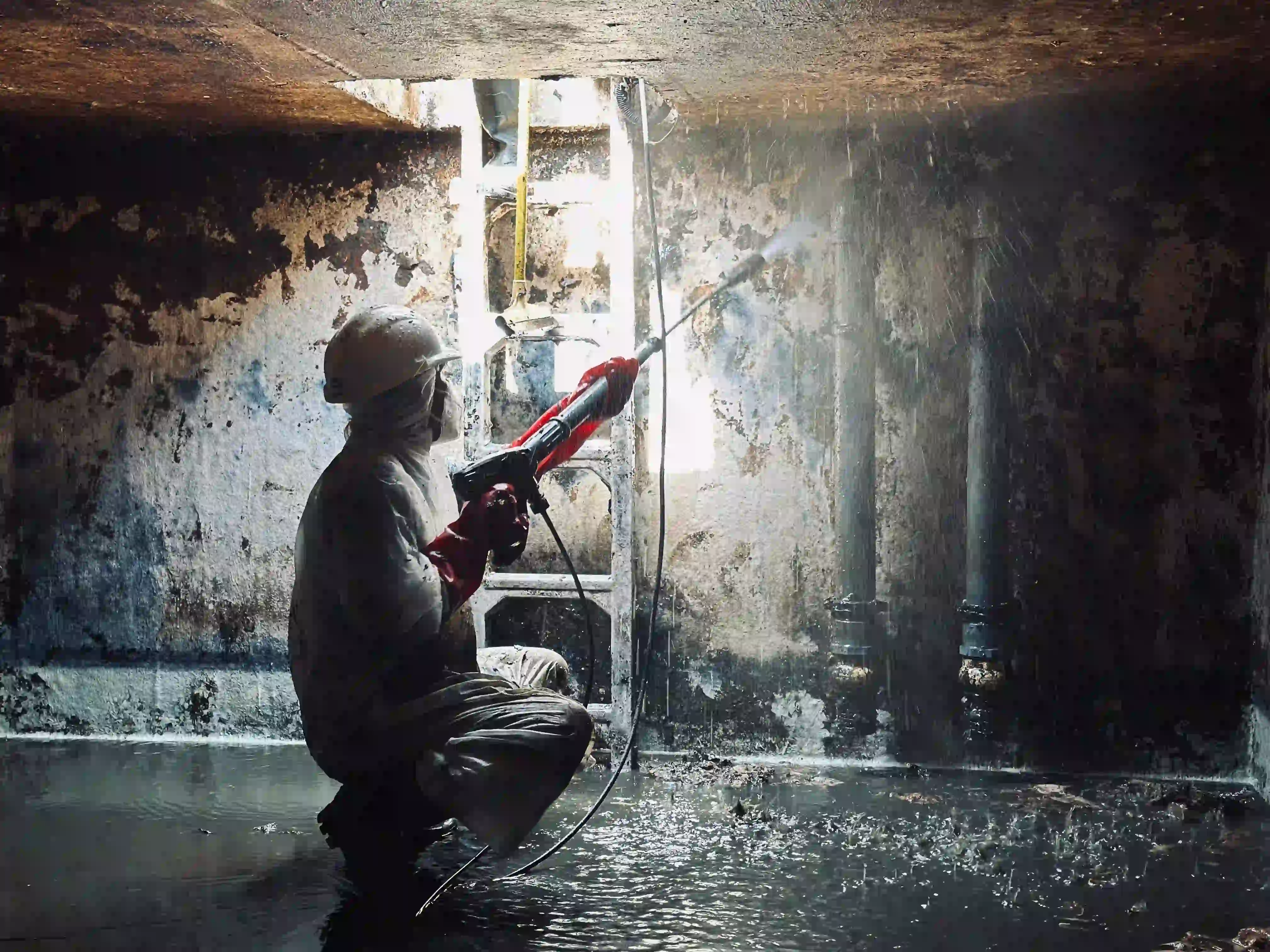
For potable water tanks — high-pressure washing with DM-approved equipment, no chemical agents on tank surfaces. Tank walls, floor, ceiling, and all fittings are scrubbed manually and high-pressure washed from top to bottom. Multiple rinse cycles until water runs clear.
For sewage and wastewater tanks — high-pressure jetting to break up sludge deposits, vacuum extraction of loosened material, internal surface cleaning.
For fuel tanks — specialist degreasing agents, vapour control throughout, vacuum extraction of sludge and contaminated residue.
For chemical tanks — neutralisation agents appropriate to the specific chemical residue, full PPE including chemical-resistant suits, sealed waste collection.
Step 5 — Disinfection (Water Tanks)
For potable water tanks, post-cleaning disinfection is mandatory under Dubai Municipality requirements. A sodium hypochlorite solution at the DM-approved concentration is applied, left for the required contact time, and then rinsed with multiple cycles of clean potable water. Chlorine residual is tested after each rinse until the reading falls within the DM-acceptable range.
Step 6 — Post-Cleaning Inspection
The internal surfaces are inspected visually before the team exits. For water tanks, water quality parameters are tested — pH, TDS, chlorine residual, and turbidity — against Dubai Municipality acceptable limits.
Step 7 — Documentation and Certification
All findings, testing results, and the cleaning completion record are documented. For potable water tanks, a DM Water Tank Cleaning Certificate is issued. Job records are available for every tank type for your facility maintenance files and DM compliance documentation.
Underground Tank Cleaning in Dubai: Process, Safety & Compliance
Underground Tank Cleaning in Dubai — Process, Safety and Compliance
What you cannot see, you tend not to maintain. Underground tanks sit beneath car parks, plant rooms, and building slabs — invisible during daily operations, inaccessible without deliberate effort, and largely forgotten until something goes wrong. A foul smell rising through floor drains. Discoloured water reaching taps. A DM inspection flagging a tank that has not been documented as cleaned in years.
Underground tank cleaning in Dubai is not simply a maintenance task. It is a confined space operation governed by specific safety regulations, carried out by certified technicians with specialist equipment, and documented for Dubai Municipality compliance. Every step of the process demands more than what a standard cleaning crew can provide.
This blog explains the full cleaning process, the safety requirements that make underground tanks different from every other cleaning job, and what Dubai Municipality expects from building owners and facility managers responsible for these assets.
What Types of Underground Tanks Are Found in Dubai Buildings?
Underground Water Storage Tanks
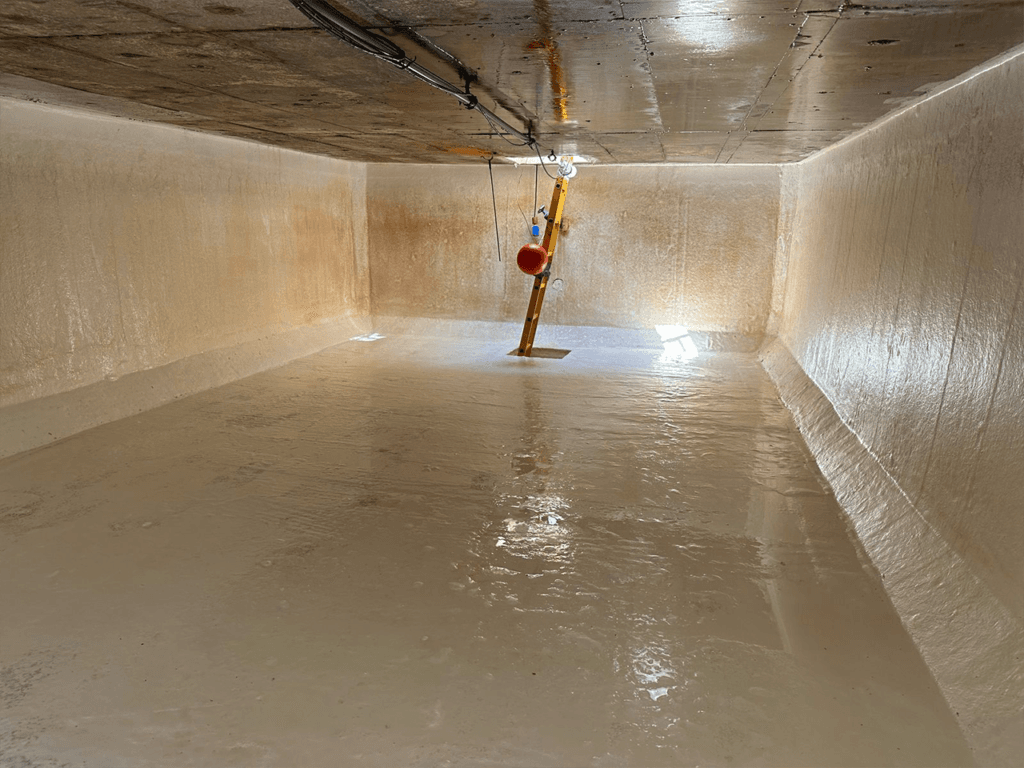
The most common underground tank in Dubai. Stores potable water pumped from the DEWA supply before distribution through the building's internal system. Subject to Dubai Municipality's mandatory six-month cleaning cycle and DM-FSD Permit requirements.
Underground Sewage Holding Tanks
Properties not connected to Dubai Municipality's main sewerage network hold sewage in underground tanks pending collection by licensed tanker services. Subject to regular emptying and periodic cleaning to remove sludge accumulation.
Underground Fuel and Diesel Tanks
Fuel stations, generator facilities, and industrial sites store diesel and fuel underground. Subject to hazardous waste handling requirements and HWTV permit conditions during cleaning.
Underground Fire Suppression Tanks
Water storage for fire fighting systems — often the largest tanks on a commercial property. Critical infrastructure that must be kept clean and sediment-free to ensure system performance.
Underground Chemical Storage Tanks
Industrial and manufacturing facilities store process chemicals underground. Specialist cleaning with chemical-specific PPE and neutralisation protocols.
Why Underground Tank Cleaning Is a Confined Space Operation
This is the point most property managers and building owners do not fully appreciate until a job goes wrong.
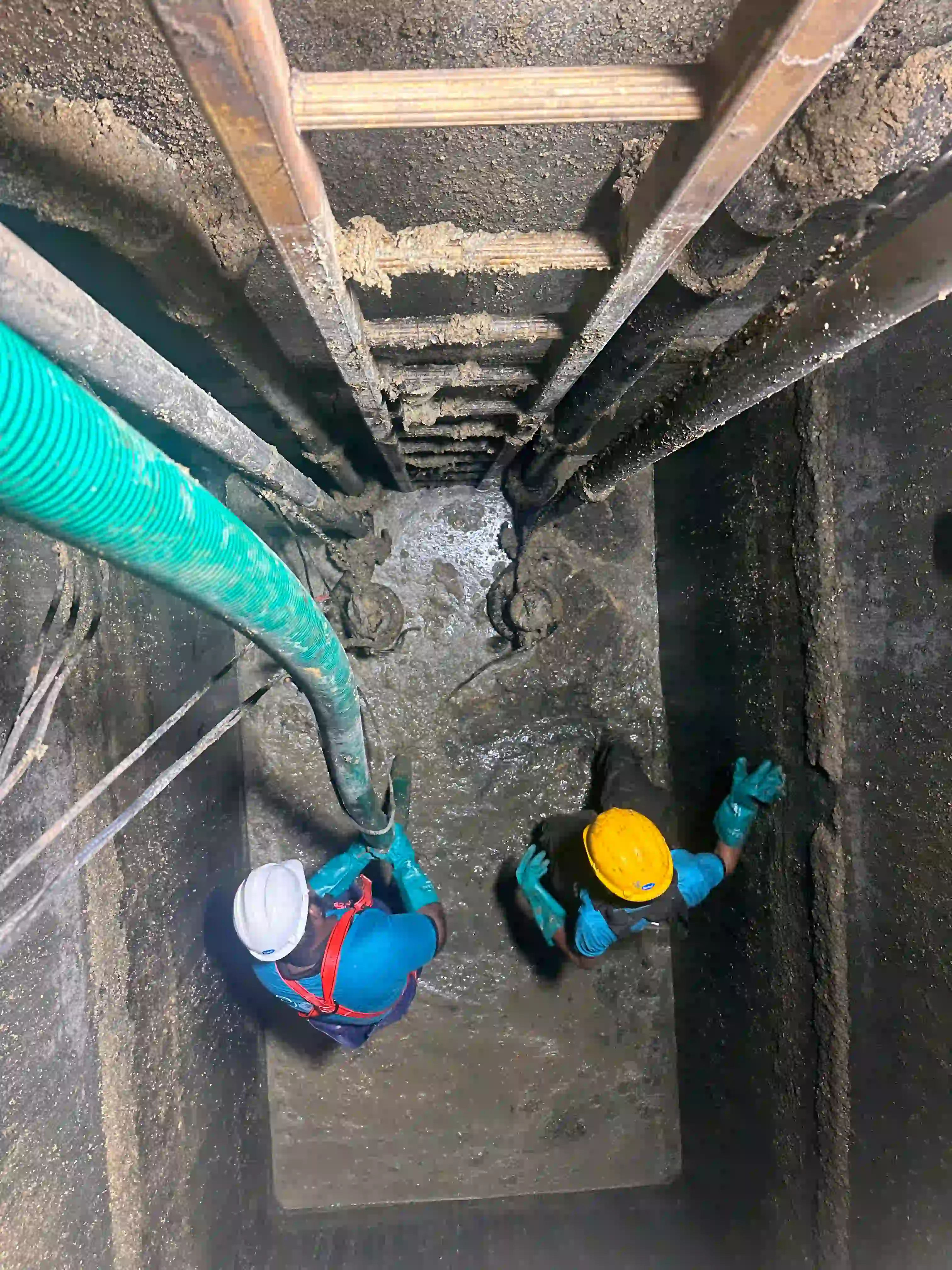
An underground tank is a confined space. It is an enclosed or partially enclosed structure — large enough for a person to enter and perform work, not designed for continuous human occupancy, and containing known hazards relating to atmosphere, engulfment, or configuration.
In Dubai, confined space entry is governed by UAE Federal Labour Law and Dubai Municipality health and safety requirements. No technician should enter an underground tank without:
A valid confined space entry permit for the specific job
Atmospheric testing before and during entry — oxygen levels, flammable gas presence, and toxic gas concentrations
Self-Contained Breathing Apparatus (SCBA) where atmospheric risk is confirmed or cannot be ruled out
Multi-gas detection equipment worn continuously during entry
A safety harness and lanyard rated for rescue extraction
A tripod-mounted rescue system positioned at the entry point
A standby person outside the tank throughout the entire entry period — never entering the space, ready to initiate rescue if needed
At Dotless, every underground tank cleaning assignment is treated as a confined space operation from the moment access is opened. Our SCBA units and tripod rescue systems hold current calibration and inspection certificates. Our technicians are trained in confined space entry procedures including emergency extraction protocols.
This is not precautionary — it is the legal and safety standard for this work in Dubai.
The Underground Tank Cleaning Process — Step by Step
Step 1 — Pre-Job Assessment and Permit Preparation
Before any access cover is opened, the team reviews the tank specification — dimensions, contents, last cleaning date, access configuration, and known hazards. A confined space entry permit is prepared for every job regardless of tank type or perceived risk level.
Step 2 — Atmospheric Testing
The access cover is opened and the tank atmosphere is tested before any person approaches the entry point. Oxygen content, lower explosive limit readings, hydrogen sulphide, and carbon monoxide are checked. Results are logged. Entry is only authorised when conditions meet safe thresholds — or appropriate respiratory protection is confirmed for conditions that do not.
Step 3 — Dewatering and Sludge Extraction
Remaining liquid is pumped out using appropriate equipment. For water tanks, drained water is handled per DM wastewater regulations. For fuel and chemical tanks, liquids are transferred to compliant containers for licensed disposal. Sludge at the base of the tank is removed by vacuum extraction before the cleaning team enters.
Step 4 — Internal Cleaning
The cleaning method is determined by tank type:
For potable water tanks — high-pressure washing with DM-approved equipment, no chemical agents on tank surfaces. Tank walls, floor, ceiling, and all fittings are scrubbed manually and high-pressure washed from top to bottom. Multiple rinse cycles until water runs clear.
For sewage and wastewater tanks — high-pressure jetting to break up sludge deposits, vacuum extraction of loosened material, internal surface cleaning.
For fuel tanks — specialist degreasing agents, vapour control throughout, vacuum extraction of sludge and contaminated residue.
For chemical tanks — neutralisation agents appropriate to the specific chemical residue, full PPE including chemical-resistant suits, sealed waste collection.
Step 5 — Disinfection (Water Tanks)
For potable water tanks, post-cleaning disinfection is mandatory under Dubai Municipality requirements. A sodium hypochlorite solution at the DM-approved concentration is applied, left for the required contact time, and then rinsed with multiple cycles of clean potable water. Chlorine residual is tested after each rinse until the reading falls within the DM-acceptable range.
Step 6 — Post-Cleaning Inspection
The internal surfaces are inspected visually before the team exits. For water tanks, water quality parameters are tested — pH, TDS, chlorine residual, and turbidity — against Dubai Municipality acceptable limits.
Step 7 — Documentation and Certification
All findings, testing results, and the cleaning completion record are documented. For potable water tanks, a DM Water Tank Cleaning Certificate is issued. Job records are available for every tank type for your facility maintenance files and DM compliance documentation.
Dubai Municipality Compliance Requirements for Underground Tanks

Dotless — Dubai's trusted waste movement partner
Dotless is a Dubai-based waste management company specialising in liquid, hazardous, medical and industrial waste collection, transport and disposal. We operate a RASID-registered tanker fleet across all 7 emirates with full Dubai Municipality permits and manifest-tracked operations.
Key Takeaways
Underground tanks in Dubai include water, sewage, fuel, fire suppression, and chemical storage types — each with different cleaning requirements
Every underground tank entry is a confined space operation requiring atmospheric testing, SCBA readiness, tripod rescue, and entry permits
Potable water underground tanks must be cleaned every 6 months under Dubai Municipality regulations by a DM-permitted contractor
Dotless holds DM-FSD Permit Sr. No. 00292 for water tank cleaning and HWTV permits for hazardous waste handling
Post-cleaning documentation and DM Water Tank Cleaning Certificates are mandatory for water tank compliance
Never allow underground tank entry without full confined space safety protocols in place
Need a waste collection? We dispatch same-day.
Related posts
Pharmacy Waste Management in Dubai
How to Choose a Medical Waste Company in Dubai
Regulated vs General Medical Waste: Dubai Guide
Ready to get it done?
Tell us what you need and we'll help you find the right service.