DHA vs Dubai Municipality — Who Actually Regulates Medical Waste Disposal in Dubai?
Most healthcare facility managers focus on one regulator when setting up medical waste management in Dubai. They build their DHA compliance file carefully, sign a waste contractor agreement, and consider the matter settled. Then a Dubai Municipality inspection reveals they have been operating with non-compliant transport vehicles for months — and the fine lands on their facility.
Medical waste management in Dubai operates under two separate regulatory bodies with distinct authority, different enforcement tools, and independent penalty systems. Satisfying one does not satisfy the other. Understanding where each regulator's jurisdiction begins and ends is the starting point for genuinely compliant hospital waste management, clinic operations, and any healthcare facility generating regulated medical waste in the Emirate.
More information
Why Two Regulators Govern Medical Waste in Dubai
Dubai's framework for healthcare waste management is built around two distinct risk zones.
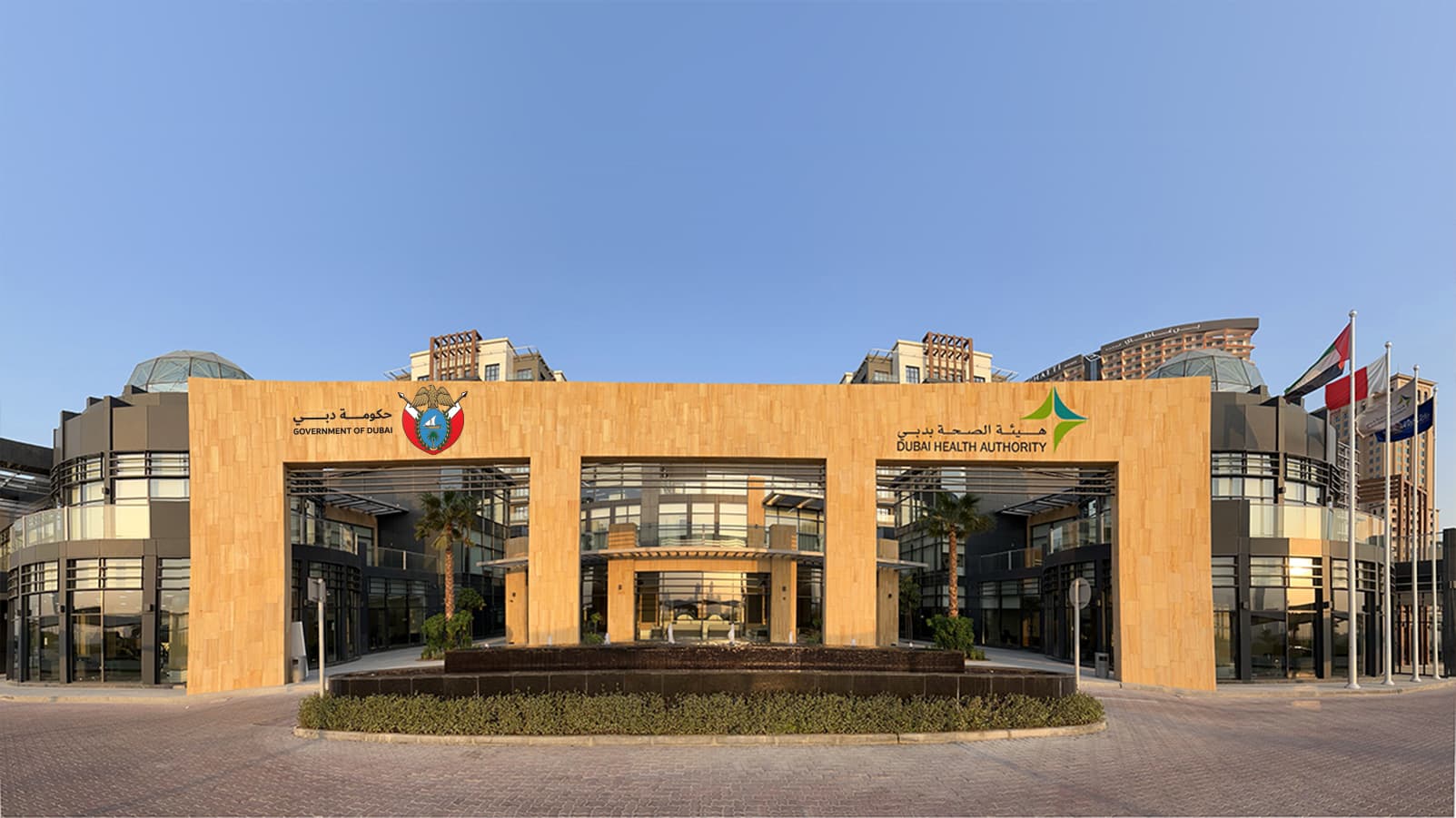
The first is inside your facility — how biomedical waste management is handled at the point of generation, how waste streams are segregated, how containers are labelled, and how material is stored before collection. The Dubai Health Authority (DHA) holds regulatory authority over this zone. DHA's mandate covers patient safety, infection control, and the operational standards of licensed healthcare premises.
The second risk zone begins the moment waste leaves your facility gate. Who collects it, in what vehicle, under what permit, tracked by what system, and disposed of at what authorised facility — all of this falls under Dubai Municipality's (DM) authority. DM's Waste Management Department governs the entire medical waste disposal and transport chain across the Emirate.
Neither body duplicates the other's inspections. DHA does not check HWTV permit numbers on transport vehicles. Dubai Municipality does not audit your clinical waste segregation trays. But both conduct independent inspections, both can issue penalties, and both must be satisfied simultaneously.
What the Dubai Health Authority Regulates
Medical Waste Management Contract — Required Before Licensing
DHA's most direct lever over medical waste management is the facility licence itself. No clinic, hospital, pharmacy, dental practice, laboratory, or healthcare centre can receive a DHA facility licence without submitting proof that a compliant medical waste management system is already operational. A signed service agreement with a Dubai Municipality-approved contractor — covering all waste types the facility generates — must be included in the initial licence application.
Applications submitted without this document are rejected before substantive review begins. The contract is not a formality. It is a gate.
What DHA Inspectors Check During Audits
During pre-licensing inspections and routine DHA facility audits, inspectors evaluate the following waste-related areas specifically:
Clinical waste management at point of generation. Waste streams must be segregated correctly: clinical waste (Type H1) separate from pharmaceutical waste (Type H2), chemical waste (Type G), sharps, and any other category. Mixed containers are a direct violation regardless of how the rest of the facility presents.
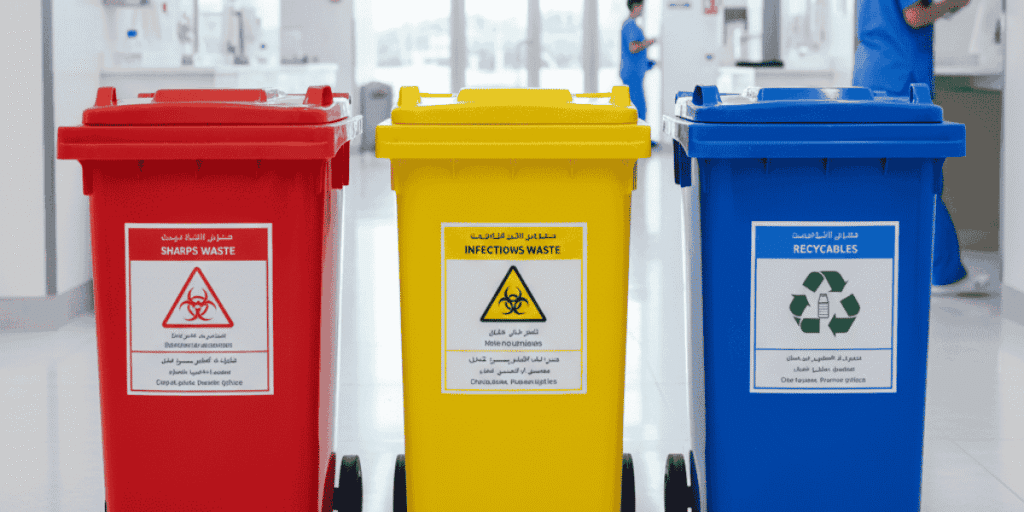
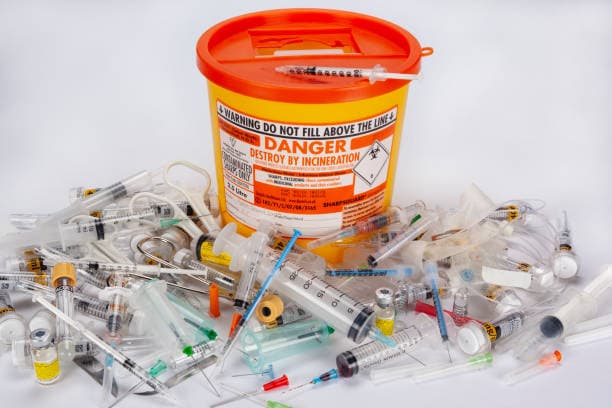
Container compliance. Yellow bags and sealed containers are mandatory for clinical and pharmaceutical waste. Red puncture-proof sharps containers are required for needles, blades, and syringes. All containers must be leak-proof, correctly labelled in English and Arabic, and matched to the volume of waste generated.
Contractor permit coverage. The service agreement must name a contractor whose active HWTV permits cover every waste type your facility produces. A contract with a contractor holding only a Type H1 permit when your facility also generates Type H2 pharmaceutical waste is treated as a non-compliant agreement — a common and costly oversight.
Disposal documentation trail. Facilities must produce disposal certificates for all waste collected. Invoices from a contractor do not substitute for certificates. If waste was collected but its journey to an authorised disposal facility is not documented, the facility is exposed during any DHA audit.
DHA Penalties
DHA enforcement operates entirely independently from Dubai Municipality. Fines for medical waste violations begin at AED 10,000 for a first infraction. Licence suspension takes effect from the date of discovery. Serious or repeated violations can result in permanent revocation, and facility owners and medical directors face personal professional sanctions under DHA's regulatory framework.
What Dubai Municipality Regulates
The WDS Permit — Disposal Authorisation for…
Every facility that generates medical or hazardous waste in Dubai must hold a valid Waste Disposal System (WDS) permit issued by Dubai Municipality through its online portal at waste.dm.gov.ae. This permit formally authorises the facility to generate, store, and have specific waste categories collected. It is valid for three months from the approval date with no extensions available.
A DHA-licensed healthcare facility operating without a current WDS permit is generating biomedical waste without disposal authorisation — a separate regulatory breach with separate penalties, entirely distinct from DHA compliance.
The HWTV Permit — Vehicle-Level Transport…
Every vehicle that physically collects medical or hazardous waste from your premises must hold a Hazardous Waste Transport Vehicle (HWTV) permit issued by Dubai Municipality's Permits and Awareness Section. This permit is granted per vehicle and per waste type category — not per company.
A contractor may present a valid trade licence and a professionally formatted service agreement while deploying vehicles with expired HWTV permits, permits covering the wrong waste category, or permits not matched to the specific vehicles arriving at your facility. The DHA inspector who reviewed your service agreement during licensing did not verify individual vehicle HWTV permit numbers. That responsibility sits entirely with Dubai Municipality enforcement.
RASID GPS Tracking — Mandatory on Every…
All vehicles transporting regulated medical waste or hazardous waste in Dubai must be registered with RASID — Dubai Municipality's Automated Vehicle Tracking and Monitoring System. RASID provides real-time location tracking of every collection run, creating a verifiable audit trail from the facility of origin to the authorised disposal destination.
A vehicle without active RASID registration cannot legally transport medical waste in Dubai under any circumstances, even if all other permits are current. Approximately 40% of contractors audited either lack RASID registration entirely or cannot produce certificates matching the vehicles actually deployed on collections.
JAHWTF and the Destruction Certificate
Dubai Municipality controls access to authorised disposal facilities for hospital waste disposal and broader hazardous medical waste disposal — primarily the Jebel Ali Hazardous Waste Treatment Facility (JAHWTF). Only vehicles with valid HWTV permits and active RASID registration are permitted to enter JAHWTF.
Following successful disposal, Dubai Municipality issues a Destruction Certificate through the WDS system. This certificate — verifiable online using a document ID and QR code — is the definitive proof that waste reached a DM-authorised facility. It is what DHA inspectors look for in your documentation trail. It is what your facility needs on file for every collection cycle.
Dubai Municipality Penalties
DM enforcement covers both waste generators and their contractors. Facilities found operating without a valid WDS permit, or using contractors with non-compliant vehicles, face fines up to AED 100,000, public listing on Dubai Municipality's violations registry, and potential criminal referral under UAE environmental law.
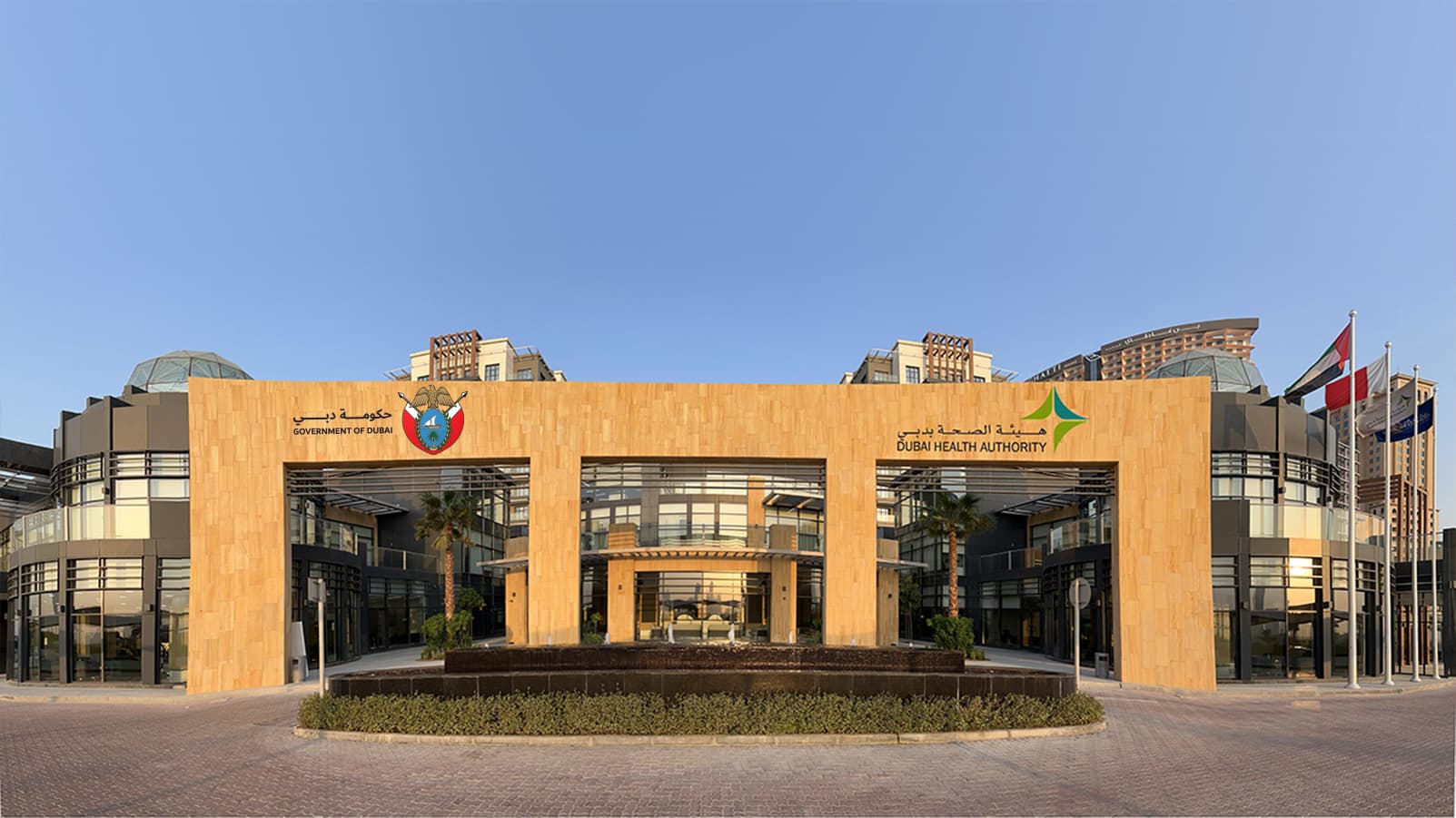
How DHA and Dubai Municipality Work Together in Practice
The two regulators do not coordinate inspections but their requirements are structurally linked from the start.
Your DHA licence application requires a service agreement with a DM-approved contractor — which immediately places you within Dubai Municipality's compliance framework. Your contractor's HWTV permits must cover the exact waste types you declared to DHA. If those two sets of categories do not align, you have created simultaneous failures under both regulators from a single oversight.
Your WDS permit from Dubai Municipality renews every three months. Each renewal requires current waste characterisation. Your DHA audit documentation must reflect ongoing disposal — certificates for every collection cycle, not just the ones that happened before your last DHA inspection.
In short: DHA compliance requires DM-compliant contractors. DM-compliant contractors satisfy the contractor requirement for DHA compliance. The two systems reinforce each other without duplicating their enforcement.
More information
The Most Common Failure Point — And Who Bears the Cost
The most frequent source of dual non-compliance is a contractor whose documentation appears valid at surface level but fails on specifics. A company can hold a current trade licence, a professionally printed service agreement, a working website, and a team who answers calls quickly — and still be operating vehicles without HWTV permits covering pharmaceutical waste, without RASID registration on their medical waste collection vehicles, without valid destruction certificates from JAHWTF.
Under Dubai's regulatory framework for biomedical waste management, the healthcare facility — not the contractor — bears legal responsibility for ensuring the contractor is fully authorised. A contractor's non-compliance is not a mitigating factor during a DHA inspection or a Dubai Municipality enforcement action. The waste generator is responsible for due diligence before the contract is signed and throughout its duration.
Frequently Asked Questions
Does DHA or Dubai Municipality regulate medical waste?
Both. DHA governs facility-level compliance — segregation, storage, containers, and contractor agreements. Dubai Municipality governs the transport and disposal chain — vehicle permits, RASID GPS tracking, and access to authorised disposal facilities. Full compliance requires satisfying both bodies simultaneously.
Do I need a WDS permit from Dubai Municipality if I already have a DHA licence?
Yes. A DHA facility licence and a Dubai Municipality WDS permit are separate documents with separate application processes. DHA licensing confirms your facility meets healthcare operational standards. The WDS permit from DM specifically authorises your waste generation and disposal activity. One does not substitute for the other.
What happens if my medical waste contractor is non-compliant?
Liability falls on your facility. Both DHA and Dubai Municipality hold the waste generator responsible for verifying that their contractor is properly licensed and compliant. If a DHA inspector or DM enforcement team finds non-compliant vehicles or missing permits, fines and enforcement actions target the healthcare facility — not just the contractor.
How do I verify my contractor's HWTV permits are genuine?
Request the permit reference numbers (format: HWTV-XXXXXX-XXXXX) and verify them directly at waste.dm.gov.ae. Confirm the waste types listed match the categories your facility generates, the expiry date is current, and the vehicle registration numbers on the permits match the vehicles that physically collect from your site.
How often does a WDS permit need renewing?
Every three months. There are no extensions. If a permit expires before the next collection cycle, your facility is operating without current disposal authorisation, even if the collection itself is carried out by a properly permitted contractor.
Need a waste collection? We dispatch same-day.
Related posts
Pharmacy Waste Management in Dubai

How to Choose a Medical Waste Company in Dubai
Regulated vs General Medical Waste: Dubai Guide
Ready to get it done?
Tell us what you need and we'll help you find the right service.