The 15% that changes everything
The World Health Organization estimates that about 15% of the waste a healthcare facility generates is hazardous — infectious, chemical or radioactive — and the other 85% is ordinary general waste. That single ratio is the whole game. Manage the split well, and you treat only the fraction that genuinely needs it. Manage it poorly, and general waste gets contaminated by the hazardous stream, your hazardous volumes balloon, your costs rise, and your compliance risk rises with them.
Biomedical waste management, stripped to its essence, is the discipline of protecting that 85% and handling the 15% correctly at every step. For a Dubai hospital or clinic, doing this well is both a licensing requirement and a genuine cost lever.
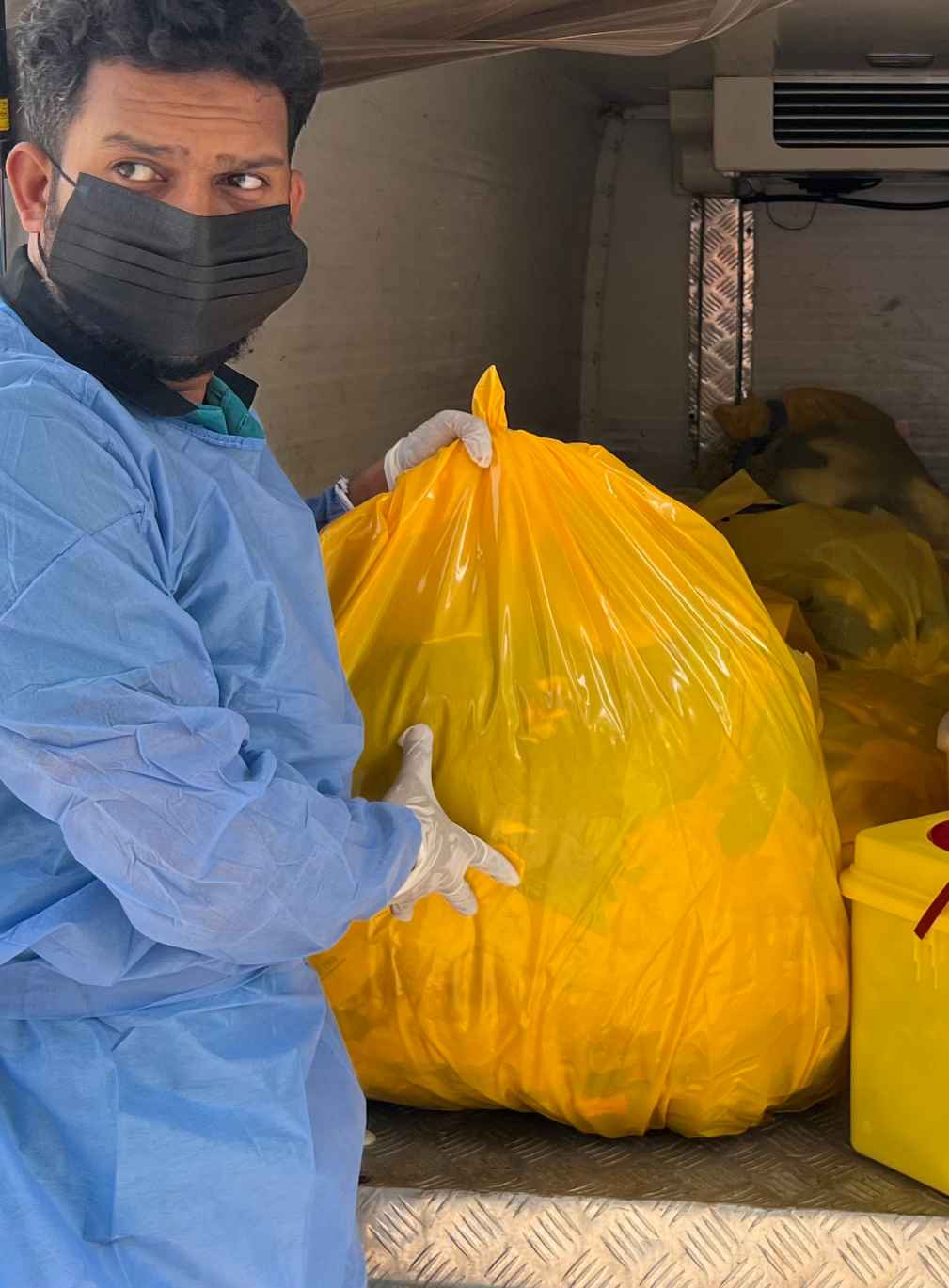
Since 2022, Dotless Green Environmental Services has collected and sent for treatment
over 240 tonnes of clinical and pharmaceutical waste — around 6–7 tonnes every month
— for hospitals, clinics and healthcare facilities across Dubai. Part of a group
operating since 2017 with 800+ clients, Dotless runs every collection under active
HWTV permits (HWTV-181225-02457, HWTV-311025-02400, HWTV-160725-02237) on
RASID-tracked vehicles, treating waste at Dubai Municipality-approved facilities
with a documented chain of custody returned.
What "biomedical waste" actually covers
Biomedical (or clinical) waste is any waste generated during diagnosis, treatment, immunisation or related research that carries a potential to infect, injure or contaminate. It ranges from a blood-soaked dressing to an expired vial of medicine to a used scalpel. The common thread is that none of it can safely enter the ordinary municipal waste stream untreated.
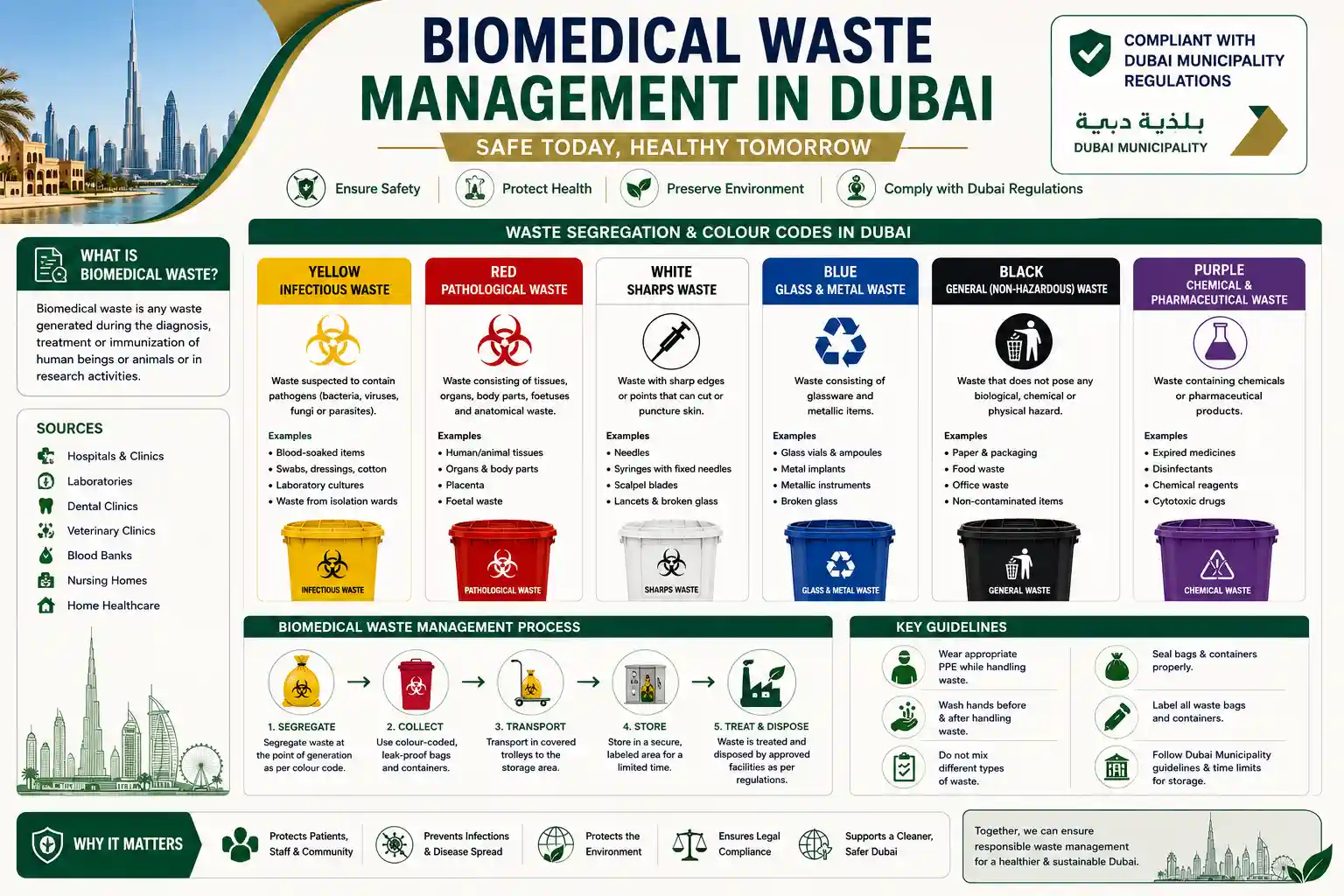
The waste categories you must manage separately
Infectious/clinical waste
Dressings, swabs, gloves, cultures and anything contaminated with body fluids.
Sharps
Needles, blades, lancets and glass, in rigid puncture-proof containers.
Pathological/anatomical waste
Tissues and body parts, handled under specific rules.
Pharmaceutical waste
Expired, unused or contaminated medicines
Chemical waste
Disinfectants, solvents, reagents and laboratory chemicals
Radioactive waste
From nuclear medicine and certain diagnostics, managed under separate controls.
Storage and internal handling
Between generation and collection, biomedical waste needs a designated internal storage area: restricted access, clearly signed, away from patients, food and public routes, and sized so waste never accumulates beyond its safe holding time. Filled bags and sealed containers move here from the point of generation and wait for scheduled collection — never in corridors, treatment rooms or reception.
Transport: the permitted link most people overlook
This is where otherwise careful facilities expose themselves. Biomedical waste can only be moved legally in Dubai by a carrier holding a valid Hazardous Waste Transport Vehicle (HWTV) permit, using approved vehicles. If your collector can't show a current HWTV permit and registered transport, the liability for improperly transported waste can trace back to you as the generator. Ask for the permit numbers, and confirm the vehicles are RASID-registered and tracked.
Treatment and final disposal
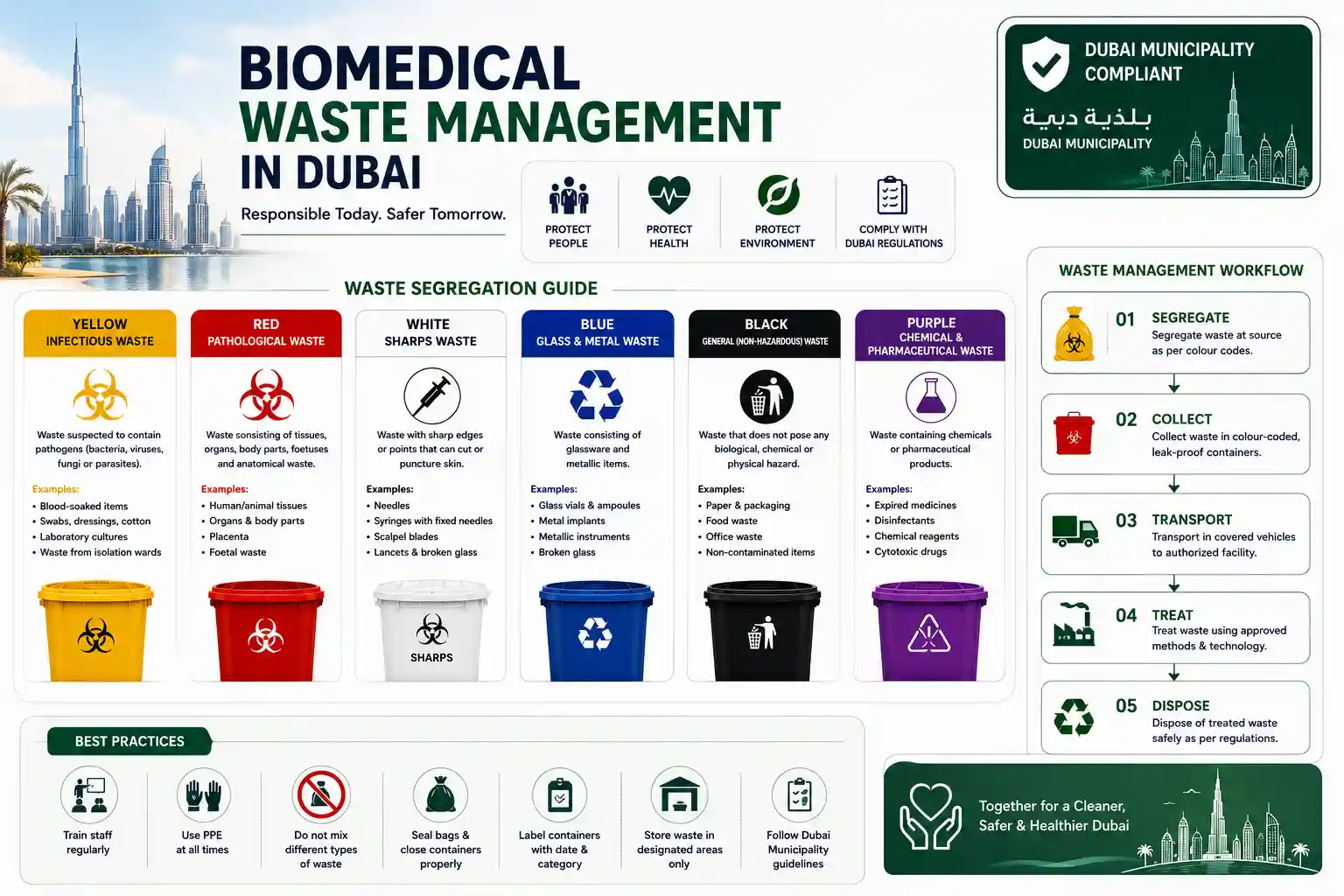
Hazardous biomedical waste is treated — typically by high-temperature incineration or equivalent approved methods — at a Dubai Municipality-approved facility, not sent to landfill. After treatment, you should receive documentation confirming what was collected and how it was treated. That paper trail is your proof of compliance.
Documentation and audit-readiness
A defensible system generates a record at every handover: collection manifests, transport documentation and treatment/disposal confirmations, retained and retrievable. When DHA or Dubai Municipality inspects, or when your facility is audited, this chain of custody is what demonstrates that your hazardous 15% was handled correctly from the bin to the burner.
Building a system that scales
For a small clinic, this can be a simple set of colour-coded bins and a scheduled collection. For a hospital, it becomes a facility-wide programme: point-of-generation segregation, internal logistics, secure storage, permitted transport, approved treatment, and a documentation loop that closes every time. The principles are identical — only the scale changes.
Dotless Green Environmental Services runs this end to end for Dubai healthcare facilities. Operating across more than 1,000 clinics and 500+ medical waste clients, Dotless collects segregated biomedical waste, transports it under active HWTV permits (HWTV-181225-02457, HWTV-311025-02400, HWTV-160725-02237) on RASID-registered, GPS-tracked vehicles, and delivers to DM-approved treatment facilities with documentation returned to the client — backed by 8+ years in operation and a 5.0 rating across 186 Google reviews.
Soft CTA: If you're standardising medical waste management across a clinic or hospital, the Dotless team can map your categories, containers and collection schedule into one documented system.
Frequently Asked Questions
What is biomedical waste?
Waste generated during diagnosis, treatment, immunisation or related research that can infect, injure or contaminate — from contaminated dressings and sharps to expired medicines and lab chemicals.
How much of hospital waste is actually hazardous?
The WHO estimates around 15% is hazardous; the remaining 85% is general waste. Keeping the two apart is the core of good management.
Can biomedical waste go to normal landfill?
No. Hazardous biomedical waste must be treated at a Dubai Municipality-approved facility, typically by high-temperature incineration or an equivalent approved method.
Who can legally transport biomedical waste in Dubai?
Only a carrier holding a valid HWTV permit with approved, registered vehicles. Always verify the permit before contracting.
What documentation should a facility keep?
Collection manifests, transport records and treatment confirmations — the chain of custody inspectors and auditors ask to see.
Does a small clinic need the same system as a hospital?
The principles are the same; the scale differs. A clinic may need colour-coded bins and scheduled collection, while a hospital runs a facility-wide programme.
Related posts
Pharmacy Waste Management in Dubai
How to Choose a Medical Waste Company in Dubai
Regulated vs General Medical Waste: Dubai Guide
Ready to get it done?
Tell us what you need and we'll help you find the right service.