Cattle Market and Livestock Yard Disinfection in Dubai — A Documented ULV Case Study
Livestock markets in Dubai carry a microbial load that no routine cleaning programme can address. Every animal that passes through a cattle yard brings bacteria, viruses, fungi, and organic waste that accumulates across concrete floors, metal fencing, feeding stations, gates, and partitions. In Dubai's summer climate — where ambient temperatures regularly exceed 45°C — pathogen survival and proliferation on these surfaces accelerates significantly compared to cooler environments.
In July 2026, Dotless Cleaning Services completed a comprehensive two-day disinfection of three cattle yards at Al Awar Livestock Trading's Dubai facility. This case study documents the scope of work, the two-method application process, the disinfectant used, the safety protocols followed, and the documentation delivered to the client.
Project Overview
Client: Al Awar Livestock Trading — Cattle Market
Location: Al Qusais, Dubai
Scope: Comprehensive disinfection of three cattle yards
Method: Spray application + ULV (Ultra Low Volume) misting
Disinfectant: Huwa San TR 50
Date of service: 5th and 6th July 2026
Work completion references: S.No. 5085 (Day 1 — three yards) and S.No. 5086 (Day 2 — one yard follow-up)
Contractor: Dotless Cleaning Services L.L.C
The Three Yards — What Was Being Disinfected
The scope covered three distinct cattle yard environments, each presenting different surface challenges:
Yard 1 and Yard 10 — concrete and tiled flooring with full metal fencing, gates, partitions, feeding stations, and structural surfaces. These enclosed yards concentrate organic waste and animal contact on hard, non-porous surfaces where biofilm and bacterial colonies establish quickly without regular chemical treatment.
Yard 79 — sand flooring, open-structure livestock holding area. Sand surfaces absorb organic waste and liquids from animal contact, creating conditions where pathogens can survive well below the surface level. Standard spray application alone is insufficient for sand environments — ULV misting is essential to achieve fine-particle penetration into surface layers and throughout the airspace of the yard.
All fencing, metal grills, gates, partitions, and accessible structural surfaces across all three yards were included in the scope.

Why Livestock Markets Require Specialist Disinfection
A standard facility cleaning service cannot address the biological challenge of a livestock market. The combination of animal waste, moisture, organic matter, high animal density, and warm ambient temperatures creates one of the most demanding disinfection environments outside of healthcare settings.
The specific risks in an undisinfected cattle yard include Salmonella in animal faeces persisting on concrete and metal surfaces for days to weeks. E. coli contamination spreading from animal waste to feeding and water areas. Foot-and-mouth disease virus surviving on surfaces and in soil. Respiratory pathogens including Pasteurella and Mannheimia circulating in the airspace of enclosed yards. Ringworm and fungal infections persisting on metal surfaces and bedding material.
None of these can be managed through pressure washing or general disinfection with standard household-grade products. The application method, the disinfectant concentration, the contact time, and the coverage of hard-to-reach surfaces all determine whether microbial load is genuinely reduced or simply displaced.
The Disinfection Approach — Two Methods Combined
Method 1 — Low-Pressure Spray Application
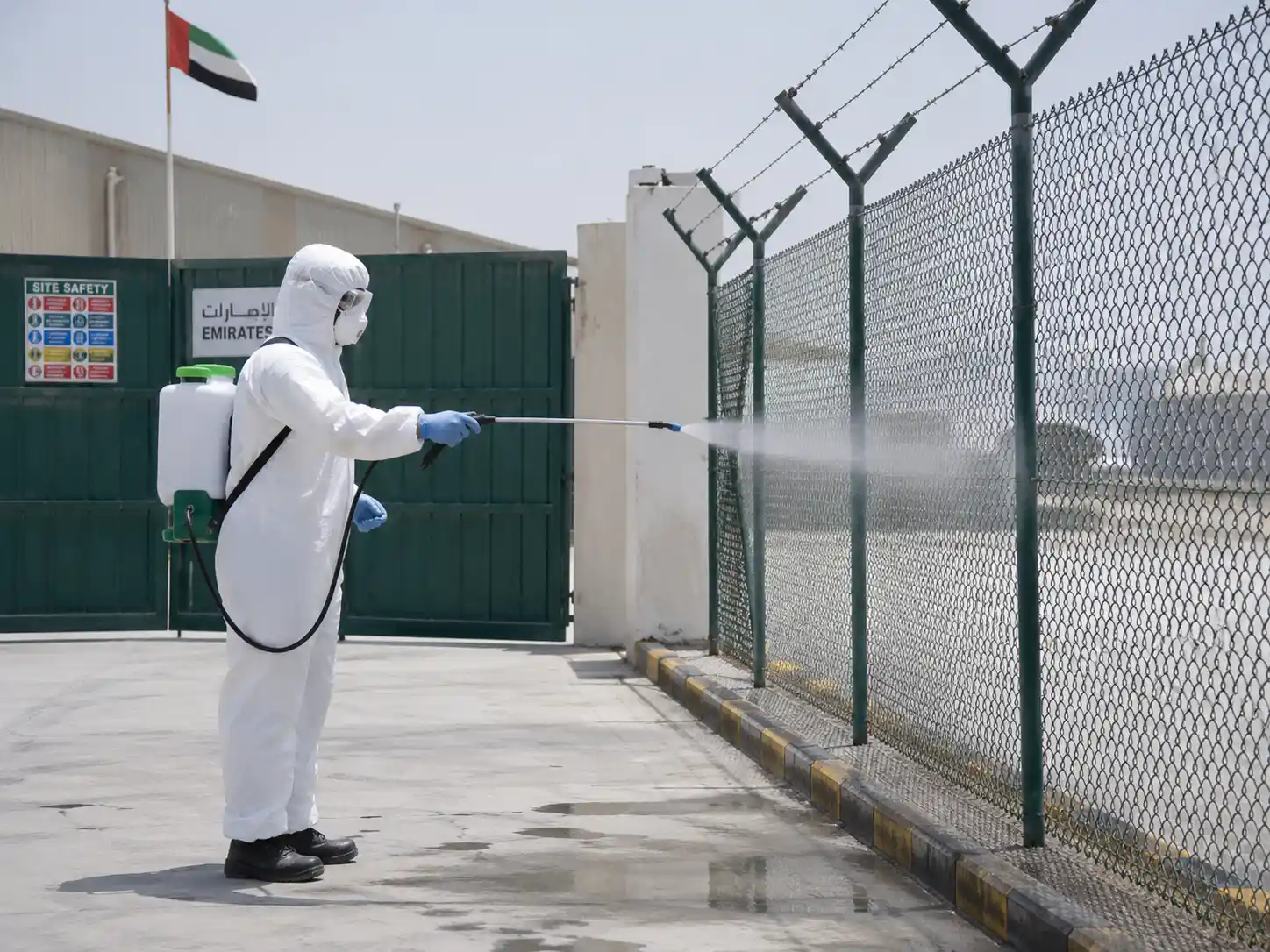
The first pass uses low-pressure spraying to apply Huwa San TR 50 to all accessible surfaces — floors, feeding areas, fencing bars, gate latches, walls, and structural components. Low-pressure application (rather than high-pressure washing) ensures the disinfectant stays on the surface long enough to achieve the required contact time rather than being dispersed or diluted.
Every bar of every fence, every gate latch, every feeding trough rim, and every accessible floor area receives direct spray coverage. This is the most labour-intensive part of the process — teams work methodically section by section across the yard to ensure no surface is missed.
Method 2 — ULV (Ultra Low Volume) Misting
The second pass uses ULV fogging machines to distribute the disinfectant as a fine aerosol throughout each yard's airspace and into areas that direct spray cannot reach — gaps between fence panels, under feeding stations, into corners, across the full ceiling height of enclosed yards, and through the surface layer of sand flooring in Yard 79.
ULV technology reduces the disinfectant droplet size to between 5 and 50 microns — fine enough to remain suspended in the air for several minutes, allowing the biocide to penetrate airborne pathogen zones that surface spraying entirely misses.
In high-animal-traffic environments like cattle markets, airborne transmission of respiratory pathogens between animals is a significant disease vector. ULV treatment of the airspace is not an optional enhancement — it is the component that addresses this transmission route directly.
Huwa San TR 50 — The Disinfectant Used
Huwa San TR 50 is a hydrogen peroxide-based biocide widely used across livestock facilities, food processing environments, and agricultural operations in the UAE.
Biocide products used in professional disinfection in Dubai are regulated under
Dubai Municipality Technical Guidelines (82) for Biocides (DM-HSD-GU82),
published by the Dubai Municipality Health and Safety Department. This guideline
governs the registration, approval, labelling, and conditions of use for all
biocidal products applied within the Emirate — including the disinfectant applied
across the Al Awar livestock yards.
For professional B2B disinfection services in Dubai, Dubai Municipality's
Technical Guidelines (86) for General Requirements for Professional Use B2B
Biocidal Products (DM-HSD-GU86) set the standards that approved contractors
must meet when applying biocidal products in commercial and agricultural
environments on behalf of client organisations.
Its active ingredient — stabilised hydrogen peroxide at 50% concentration, diluted to application concentrations before use — delivers broad-spectrum activity against bacteria, viruses, fungi, and spores.
Key properties for livestock market use: it leaves no harmful residues on treated surfaces once dry, it is effective on non-porous surfaces including concrete, tile, and metal, it penetrates organic matter present on surfaces when used at correct concentrations, and it does not require rinsing after application in outdoor and semi-enclosed agricultural environments.
The disinfectant was prepared and diluted in accordance with the manufacturer's specified concentrations before application. All mixing was carried out by trained personnel with appropriate protective equipment.
Safety and PPE Standards
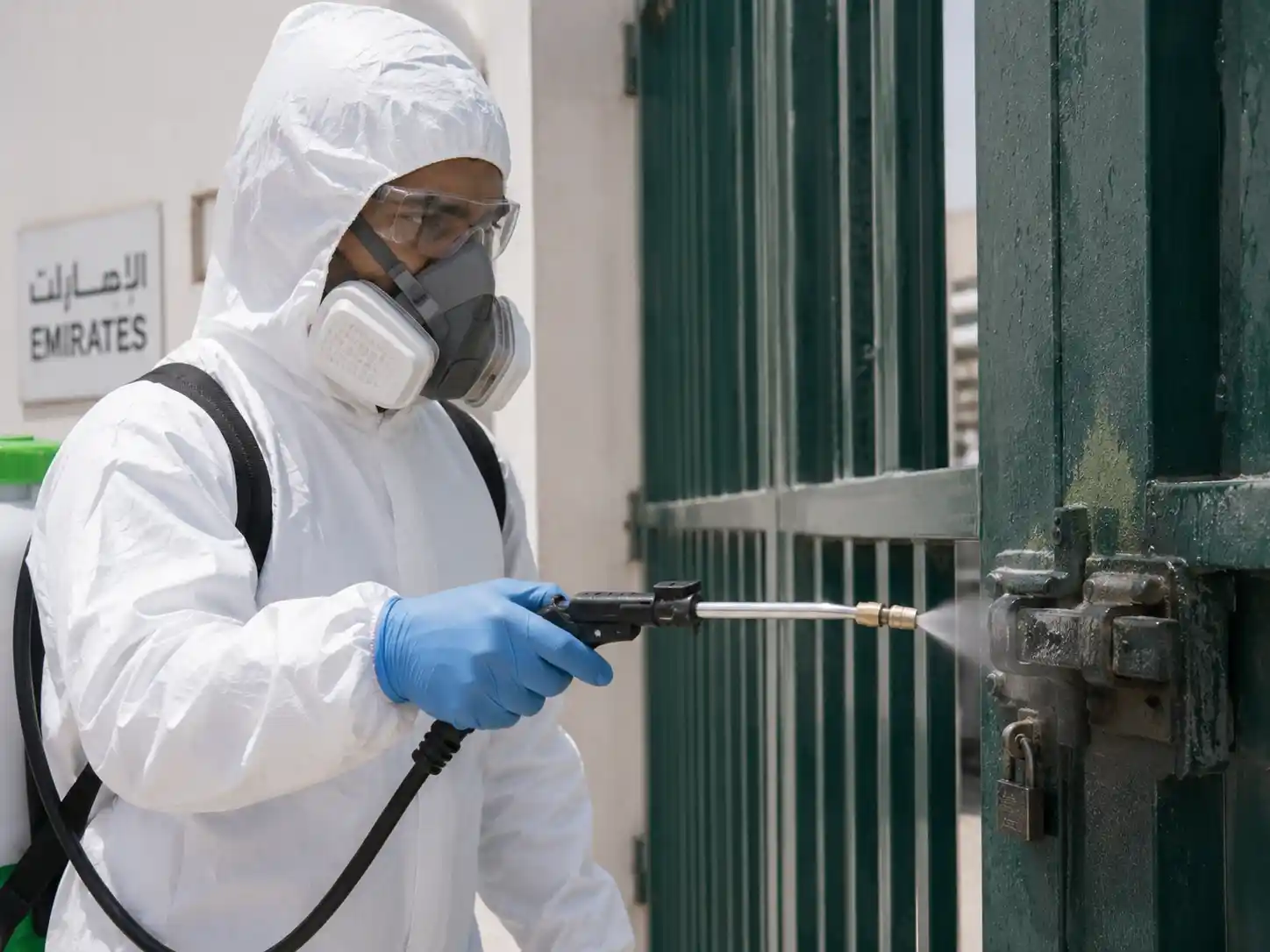
All disinfection personnel wore full personal protective equipment throughout the operation — covering every aspect of chemical and biological exposure risk in a live livestock facility environment. This included full-body disposable coveralls, full-face respirator masks providing both particulate and chemical vapour protection, protective gloves, eye protection, and disposable shoe covers.
Work on both days was carried out with appropriate safety barriers in place around active treatment zones. All water tank inlets and outlets in relevant areas were protected from chemical contamination during the operation. Animals were removed from disinfected areas before treatment commenced and kept out until the required contact time and drying period had been completed.
The Two-Day Scope
Day 1 — 5 July 2026 (Work Completion S.No. 5085):
Full disinfection of all three cattle yards — Yard 1, 10, and 79 — covering all accessible flooring, fencing, metal grills, gates, partitions, and structural surfaces using both spray and ULV misting methods.Day 2 — 6 July 2026 (Work Completion S.No. 5086):
Follow-up disinfection of one cattle yard, including application of approved disinfectant by spray and ULV misting to all accessible floors, fencing, metal grills, gates, partitions, and structural surfaces. Carried out in accordance with the approved scope of work.
Both days confirmed complete in a satisfactory manner and signed off by the Dotless manager and the site team leader.
Completion Documentation Issued
At project completion, the client received a full documentation package confirming the work carried out, the method and disinfectant used, and the coverage of all three yards. The Disinfection Certificate confirms that Al Awar Livestock Trading Cattle Market — Yards 1, 10, and 79 — was disinfected using Dubai Municipality approved disinfectants on 5th and 6th July 2026, and that the disinfection process followed on-site complies with industry best practices to proactively prevent infections from the treated surfaces.
Which Facilities Need This Service?
The disinfection scope completed at Al Awar Livestock Trading applies to a broad range of Dubai facilities managing animal environments, food handling, or high-density human activity.
Livestock and agricultural: Cattle markets, camel yards, sheep and goat markets, poultry farms, veterinary holding facilities, and agricultural export staging areas.
Food sector: Fish markets, meat processing facilities, abattoirs, cold storage facilities, food distribution warehouses, and commercial kitchen environments.
Community and institutional: Animal shelters, stables and equestrian facilities, kennels, and any facility with regular animal or high-density human contact.
Industrial and commercial: Waste collection points, construction camps, labour accommodation, large warehouse facilities, and any premises requiring post-incident or outbreak sanitization.
All of these environments share the same core challenge — standard cleaning cannot achieve the microbial load reduction needed. Specialist chemical disinfection using the correct method, the correct biocide at the correct concentration, and the correct contact time is required to achieve a verifiable reduction in pathogen levels.
Frequently Asked Questions
What disinfection method is used for cattle yards and livestock markets?
Cattle yards require a combination of direct spray application and ULV (Ultra Low Volume) misting. Spray application covers all accessible surfaces including concrete floors, metal fencing, gates, and feeding areas. ULV misting distributes fine aerosol particles into hard-to-reach areas, gaps between fence panels, overhead structural elements, and the airspace of enclosed yards. Together, the two methods deliver complete surface and airspace disinfection.
What disinfectant is used for livestock facility disinfection?
Huwa San TR 50 — a stabilised hydrogen peroxide-based biocide — is used for livestock and agricultural facility disinfection in the UAE. It is effective against bacteria, viruses, fungi, and spores across concrete, tiled, metal, and sand surfaces. It leaves no harmful residues after drying and does not require surface rinsing in agricultural environments
Can animals re-enter the yard immediately after disinfection?
No. Animals must be kept away from treated areas while the disinfectant achieves its required contact time and until surfaces are dry. The specific re-entry interval depends on the product used and application concentration. Dotless provides post-treatment guidance on re-entry timing as part of every disinfection job.
How often should a livestock facility be disinfected?
Frequency depends on animal throughput, housing density, and regulatory requirements. High-traffic livestock markets should disinfect at scheduled regular intervals. Immediate disinfection is required after any disease outbreak, after the Eid Al Adha livestock trading season when animal movement and microbial load peaks significantly, and following any incident of confirmed infectious disease in housed animals.
Is specialist disinfection required in addition to routine cleaning?
Yes. Routine cleaning removes visible dirt and organic matter but does not achieve pathogen-level microbial reduction. Specialist disinfection using appropriately concentrated biocides at specified contact times is required to address bacteria, viruses, fungi, and spores that survive routine cleaning. In livestock environments, routine cleaning and specialist disinfection serve different functions and are both necessary.
Does Dotless provide a certificate after livestock disinfection?
Yes. Every completed disinfection job includes a work completion report confirming the scope of work, the disinfectant used, the areas treated, and the service dates. A Disinfection Certificate is issued confirming that the premises were treated using Dubai Municipality approved disinfectants in accordance with industry best practices.
Regulatory References:
Dubai Municipality Technical Guidelines (82) for Biocides (DM-HSD-GU82) —
Health and Safety Department, dm.gov.ae/documents/hsd-gu82/
Dubai Municipality Technical Guidelines (86) for General Requirements for
Professional Use B2B Biocidal Products (DM-HSD-GU86) — Health and Safety
Department, dm.gov.ae/documents/hsd-gu86/
Need a waste collection? We dispatch same-day.
More case studies
Food Product Destruction Dubai | DM Certificate
Read case study
Water Supply Disinfection Case Study
Read case study